

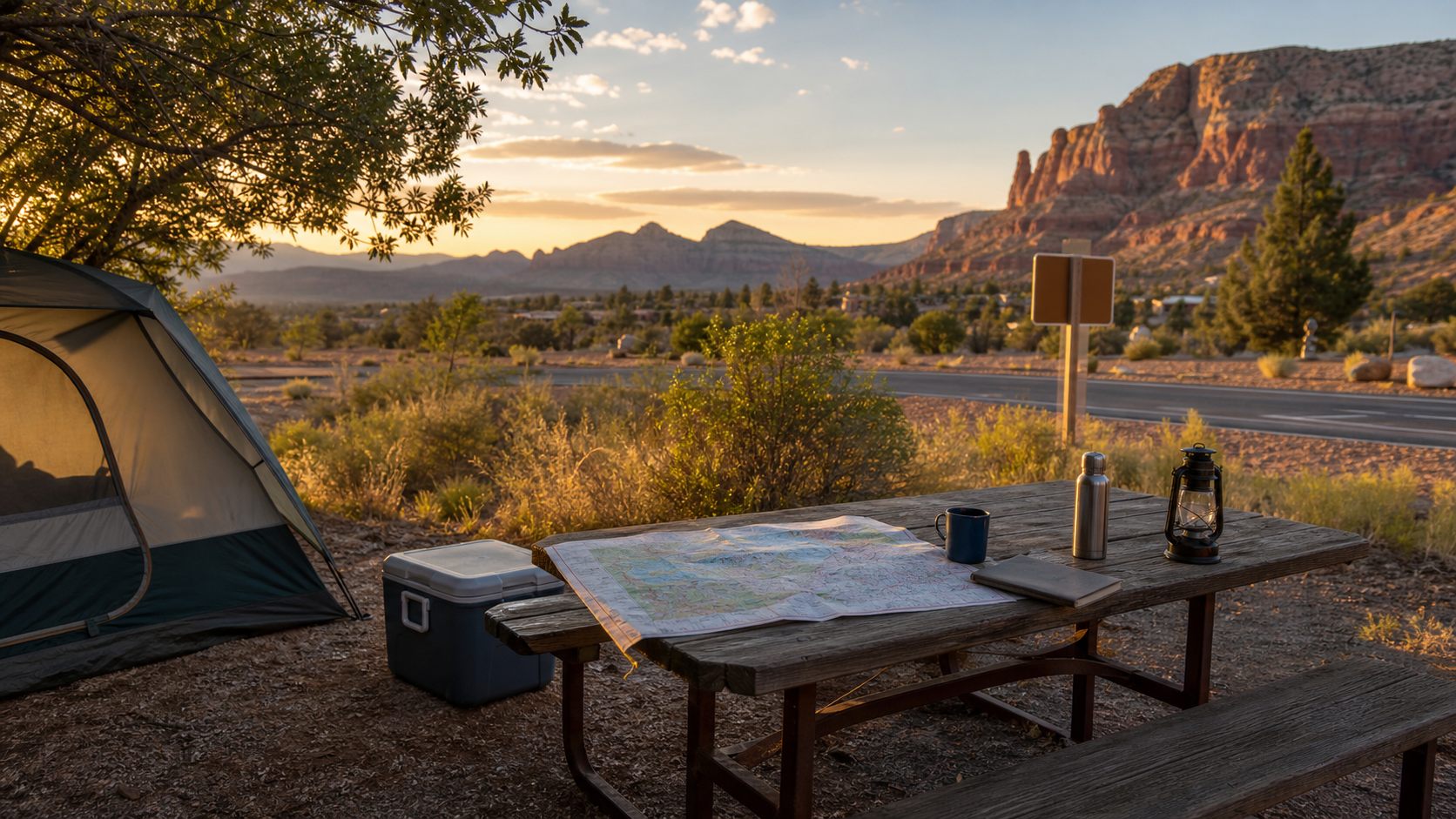
Camping near national parks works best when you treat the park campground as one option, not the whole plan. Build a search ring around the park, check official park pages first, then compare gateway-town private campgrounds, nearby National Forest or BLM land, state and local parks, and realistic cancellation backups before you drive.
This guide is written for US campers planning a national-park-adjacent trip. It is research-only, uses no affiliate links, and does not claim that Trail Gear Review tested any campground, booking tool, route, or campsite.
The Short Version
If the national park campground is full, start with the official park website and Recreation.gov, then widen the search outside the boundary. Look for nearby gateway-town campgrounds, private campgrounds, National Forest campgrounds or dispersed camping, BLM camping where available, state parks, county parks, and city or regional campgrounds.
The important rule is simple: outside the park does not mean unregulated. Every backup needs a legal campsite, a managing agency or campground contact, a reservation or first-come-first-served plan, current fire and food-storage rules, water information, and a fallback if you arrive late or lose cell service.
Why Outside-the-Park Camping Needs Its Own Plan
Campground availability is a real trip-planning constraint. The Dyrt’s 2026 Camping Report says more than half of surveyed campers had difficulty booking a site because campgrounds were full, and it reports 82.4 million campers in 2025. For national park trips, that pressure can show up months before departure.
The National Park Service says many park campgrounds require reservations through Recreation.gov, and that park websites and the NPS app are the best sources for park-specific camping information. That matters because the correct answer can vary by park, season, campground, vehicle type, permit rule, and operating status.
Do not treat a parking lot, roadside pullout, picnic area, or trailhead as a backup campsite unless the managing agency specifically allows it. Yellowstone, for example, states that car camping or overnight vehicle parking is not allowed in pullouts, parking areas, picnic grounds, or anywhere other than a designated campground inside the park. Other parks have their own rules, but the safe planning habit is the same: verify before you sleep there.
Start With a Search Ring Around the Park
Before opening every campground website at once, draw a practical search ring. Use the park entrance, visitor center, or trailhead you care about as the center point, then choose a realistic driving radius for morning and evening travel.
For many trips, the first ring is 15 to 30 miles from the entrance. The second ring might be 30 to 60 miles. A longer radius can work for scenic road trips, but it may stop feeling like camping near the park if the drive turns into a daily commute.
Build the list in layers:
- In-park campgrounds and cancellation openings.
- Campgrounds just outside the entrance or in gateway towns.
- Nearby National Forest developed campgrounds.
- National Forest dispersed camping where rules and conditions support it.
- BLM campgrounds or dispersed camping where BLM land actually exists near the route.
- State parks, county parks, city parks, and regional campgrounds.
- Private campgrounds, RV parks, cabins, glamping sites, or simple tent sites.
Some official park pages help with this. Grand Teton’s camping page, for example, points campers toward nearby options including national forest, Yellowstone, and private campgrounds in the local area. Treat those official pointers as starting points, then verify details with the actual campground or land manager.
Use Gateway Towns and Private Campgrounds for Services
Gateway-town and private campgrounds are often the most practical outside-the-park option when you need showers, laundry, a camp store, hookups, late check-in, pet-friendly rules, or easier road access. They can also be useful for arrival night before moving closer to the park.
The tradeoff is cost and fit. A private RV-focused campground may have amenities you do not need as a tent camper. A cheaper site farther away may cost more after fuel and time. Use Trail Gear Review’s budget camping planning approach here: compare the full trip cost, not only the nightly campsite fee.
Check these details before booking:
- Distance to the park entrance you will actually use.
- Check-in and late-arrival rules.
- Tent, RV, trailer, pet, generator, and vehicle-length rules.
- Cancellation and change policies.
- Quiet hours and campground style.
- Whether the site has shade, potable water, toilets, showers, or hookups.
- Road access in the season you are visiting.
Recreation.gov’s standard reservation policies are a useful reminder even when you book elsewhere: cancellation timing and fees can vary by inventory type and facility. Read the exact campground policy before treating a backup reservation as risk-free.
Check Nearby National Forest Camping Carefully
National Forest land is one of the most common outside-the-park alternatives in the western US, but it is not one single campground system. You may find developed Forest Service campgrounds, first-come-first-served sites, group sites, or dispersed camping outside developed campgrounds.
The Forest Service describes dispersed camping as camping outside a designated campground. That can mean fewer services or no services: no potable water, no toilets, no trash removal, no picnic table, and no campground host. It can also mean local restrictions, closed areas, permit requirements, road limitations, fire rules, and stay limits.
Use National Forest options in this order:
- Search the specific national forest or ranger district near the park.
- Check developed campgrounds first if you need toilets, water, or easier arrival.
- If considering dispersed camping, confirm where it is allowed and where it is not.
- Check road access, seasonal closures, fire restrictions, and whether your vehicle can reach the area safely.
- Download or print maps before you leave reliable service.
If the route involves forest roads, pair this step with Trail Gear Review’s guide to planning routes on public lands and an offline navigation backup plan. A legal campsite still needs a legal and realistic route.
Use BLM Camping Where It Is Actually Available
BLM camping can be a good option near some national parks, especially in parts of the West, but it is not evenly distributed around every park. Do not assume BLM land exists near your destination just because you have seen people camp on public land elsewhere.
BLM says most BLM lands allow dispersed camping unless an area is posted closed to camping or has specific restrictions for land use or conservation. BLM also says dispersed camping is generally limited to 14 days within a 28-day period, while specific stay limits vary by state and field office.
That local variation is the key. Before relying on BLM land, identify the field office, check the local page or map, and look for special recreation management areas, permit rules, fire restrictions, closed routes, wildlife or conservation restrictions, and site-specific stay limits.
BLM dispersed camping is usually a self-sufficiency choice. Bring enough water, a toilet/waste plan where required, trash storage, food storage, navigation, and a conservative arrival plan. If you are new to dispersed camping, a developed public campground may be the better first backup.
Add State, County and Local Parks to the Backup List
State parks are easy to overlook when the trip is built around a national park, but they can be excellent backup layers. Some sit near national park gateways, scenic highways, lakes, beaches, historic sites, and trail systems. America’s State Parks provides a state-by-state park finder with camping filters, which can help you identify the right state agency or park system to check.
Also search county, city, municipal, and regional park campgrounds. These may not appear in the same systems as federal campgrounds, and their reservation rules can be completely different. Some use state booking portals, some use third-party systems, and some require direct phone or website booking.
For each public park option, verify:
- Reservation system and booking window.
- Tent, RV, vehicle, pet, and group-size rules.
- Water, toilets, showers, dump stations, and trash.
- Gate hours and late-arrival procedure.
- Fire rules and local alerts.
- Whether the campground is actually near the entrance, trail, or viewpoint you care about.
If you choose a less-developed public option, use the same low-impact habits you would use anywhere else: camp on durable surfaces, pack out trash, respect quiet hours, store food properly, and avoid creating new fire rings or informal campsites. Trail Gear Review’s Leave No Trace camping checklist is a good companion for that part of the plan.
Build a Reservation and Cancellation Backup Workflow
Do not wait until the park campground is sold out to start the backup search. Set the backup layers before the main booking window opens, then adjust as availability changes.
Use this workflow:
- Choose your target park dates and the entrance or area you want to visit.
- Check the official park campground page and Recreation.gov where applicable.
- Save two or three nearby alternatives in each search layer: gateway/private, National Forest, state/local, and public-land dispersed only if suitable.
- Read cancellation, change, late-arrival, and no-show rules before booking a backup.
- If cancellation alerts are available, watch the in-park campground and a few realistic nearby options.
- Keep one legal fallback until the trip is confirmed.
- Recheck alerts, weather, road status, fire restrictions, and campground rules close to departure.
This is where camping apps for planning and offline maps can help, as long as the official source remains the final rule check. Apps can organize the search, but park pages, land-manager pages, Recreation.gov facility pages, and campground rules control what is actually allowed.
Do the Rule and Safety Checks Before You Drive
The farther you move from a developed in-park campground, the more responsibility shifts to your planning. Before leaving home, answer these questions for every backup campsite:
- Is camping legally allowed at this exact location?
- Who manages the land or campground?
- Do you need a reservation, permit, pass, or payment?
- Are fires allowed, restricted, or banned?
- Is potable water available?
- Are toilets, trash, bear boxes, or food lockers available?
- What are the food-storage rules?
- Is the road open and suitable for your vehicle?
- Is there reliable cell service, and if not, what is the offline plan?
- What is the legal backup if the site is full or inaccessible?
NPS camping guidance tells campers to check potable water, maximum group size, park regulations, and food-storage requirements. NPS campfire guidance also says campers should confirm whether fires are permitted and buy firewood near the campground or collect it only where rules allow.
These checks are not extra paperwork. They prevent the common bad outcomes: arriving after dark with no legal place to sleep, discovering the road is closed, assuming a fire is allowed when restrictions changed, or relying on a dispersed site without water, toilets, maps, or a trash plan.
Outside-the-Park Camping Checklist
Use this list once you have a target park and travel dates.
- Check the official national park campground page first.
- Search Recreation.gov where the park uses it.
- Save the NPS app or park page information for offline access if service may be limited.
- Draw a realistic 15- to 30-mile and 30- to 60-mile search ring.
- List gateway-town and private campgrounds near the entrance you will use.
- Check nearby National Forest campgrounds and ranger-district rules.
- Check BLM options only where BLM land is actually near the route.
- Add state, county, city, and regional park campgrounds.
- Compare total cost: site fee, fuel, cancellation risk, services, and driving time.
- Verify water, toilets, trash, food storage, fires, pets, vehicle size, and arrival rules.
- Download maps, confirmations, and campground details before leaving service.
- Keep a legal backup until the final campsite is confirmed.
- Do not sleep in park pullouts, parking lots, trailheads, or picnic areas unless the managing agency explicitly allows it.
Bottom Line
Camping near national parks is usually easier when you stop treating the park campground as the only acceptable answer. The strongest plan has layers: official park reservations, gateway-town campgrounds, National Forest options, BLM land where it actually applies, state and local parks, private campgrounds, and cancellation checks.
The best backup is not the closest empty patch of ground. It is a legal campsite with verified rules, realistic access, enough services for your group, a fire and food-storage plan, and an arrival strategy that still works if the famous campground never opens.