

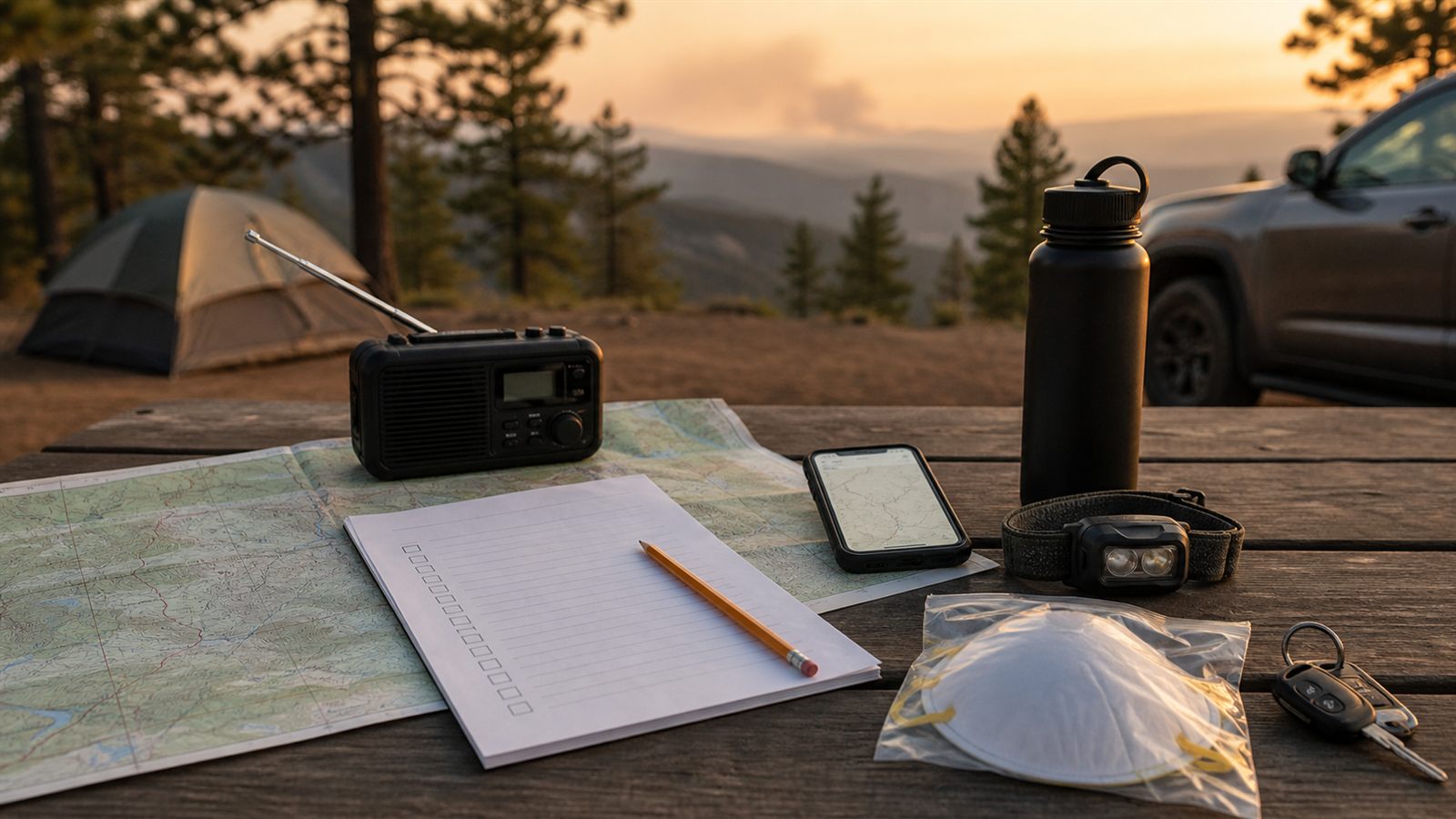
Wildfire smoke can turn a simple camping weekend into a trip that needs a different destination, a shorter route or a full cancellation. The hard part is not finding one more app. It is checking the right official sources, setting your go / change / cancel thresholds before emotions take over, and keeping backup plans available when cell service gets weak.
This checklist is written for US campers planning a frontcountry campground, car-camping or easy dispersed-camping trip during wildfire season. It is research-only, uses no affiliate links and does not claim that Trail Gear Review tested a campsite, route, respirator or smoke plan.
Quick Answer: The Go / Change / Cancel Rule
Before you leave, make a simple decision:
- Go only if the campground is open, the route is open, local fire rules allow your planned setup, the smoke forecast is acceptable for your group and you have a backup route.
- Change the plan if smoke is moving toward camp, AQI is trending worse, the route passes near an active incident, the forecast brings strong wind or thunderstorms, or your group includes someone more sensitive to smoke.
- Cancel or move the trip if an evacuation order, closure, unsafe route, unhealthy smoke level for your group, red-flag fire-weather concern or land-manager instruction makes the plan unreasonable.
That decision should come from official sources, not a single campground review or a social post. Start with AirNow wildfire resources for smoke and AQI, NIFC or InciWeb for wildfire incident context, the specific park, forest or campground for closures, and the National Weather Service for weather and fire-weather conditions.
Seven Days Out: Start Watching Smoke, Fire and Weather
About a week before departure, build a watch list. Conditions may change, but this early check tells you whether the trip needs a backup destination before the last minute.
Check:
- AirNow wildfire resources and the Fire and Smoke Map for smoke and air-quality context.
- The campground, park, forest, BLM field office or state/local land-manager page for alerts.
- NIFC and InciWeb for active fire information near the campground or along the route.
- The National Weather Service forecast for heat, wind, thunderstorms and fire-weather context.
- Recreation.gov reservation policies or the booking platform for reservation rules, change windows and cancellation policy details.
- Your backup route, alternate campground and a lower-smoke day-use or lodging option if the trip becomes marginal.
If the early check shows nearby incidents, repeated smoke impacts or uncertain access, do not wait until departure morning to think about alternatives. Make the backup plan while you still have time to change reservations, notify your group and repack.
For app and offline-source planning, pair this step with Trail Gear Review’s guide to camping apps for planning, weather and offline maps.
Forty-Eight Hours Out: Check AQI, Incidents and Closures Again
Two days out, treat the plan as provisional. This is when the article stops being general research and becomes a real decision for your exact campground.
Run this pass:
- Check the AirNow AQI forecast and nearby monitors for the destination and route towns.
- Use the Fire and Smoke Map to compare smoke near the campground, not just near your home.
- Review NIFC or InciWeb incident pages for active fires that may affect the route.
- Check the exact park, forest, campground or public-land office for closures, alerts and fire restrictions.
- Search for road closures through official state or local transportation sources if the route crosses fire-prone areas.
- Recheck NWS forecasts for wind shifts, dry lightning risk, heat and storms.
- Confirm whether campfires are allowed, restricted or irrelevant because your plan should use a stove or no-fire evening.
If your destination is managed by a park, forest or local agency, the manager’s alert page matters more than a general map. A smoke map may show regional conditions, but only the responsible land manager can tell you whether a campground, road, trail or fire ring is open.
Same Day: Make the Final Go, Change or Cancel Decision
On departure day, do one final check before loading the cooler or driving into weak service.
- Check local alerts and evacuation information for the destination and route.
- Recheck AirNow AQI and smoke for the destination, route and backup destination.
- Recheck NIFC/InciWeb or local fire sources for nearby incident changes.
- Recheck the campground or land-manager alert page for closures and restrictions.
- Recheck NWS weather, especially wind, heat, thunderstorms and fire-weather conditions.
- Decide whether the trip is still a go, should move to the backup destination or should be cancelled.
- Save screenshots or offline copies of confirmations, maps, alerts and contact numbers before leaving coverage.
Do not drive into an evacuation area or ignore instructions from local authorities because the reservation is paid for. Ready.gov wildfire guidance advises people in wildfire-risk areas to sign up for local alerts, know evacuation routes and follow instructions from local authorities. A camping trip should fit inside that guidance, not compete with it.
How to Use AQI Without Overcomplicating It
AQI is not the whole decision, but it is one of the clearest smoke checks. AirNow’s AQI Basics explain that values above 100 are unhealthy for sensitive groups and values above 150 are unhealthy for everyone.
Use that as a planning framework:
- If anyone in your group is smoke-sensitive, make the threshold more conservative.
- If AQI is forecast to worsen during the trip, treat a marginal campground as a change-plan candidate.
- If AQI reaches unhealthy levels for your group, move the trip, shorten it or cancel rather than trying to tough it out.
- If the forecast is uncertain, choose the destination with cleaner air, better access, more exits and easier communication.
The CDC wildfire smoke guidance notes that people with heart or lung disease, older adults, children, pregnant people and people who work outdoors may be at higher risk from wildfire smoke. This article is not medical advice. If someone in your group has asthma, COPD, heart disease, pregnancy-related concerns or another smoke-sensitive condition, use their clinician’s guidance and official public-health alerts as the deciding standard.
Check Fire Activity Near the Route, Not Just the Campground
Campers often check the destination and forget the drive. That can miss the real problem: smoke, road restrictions or fire activity between home and camp.
Look at:
- Active fire incidents near the campground.
- Incidents upwind of the destination.
- Fires near the main highway, forest road or access road.
- Smoke along the return route, not just the arrival route.
- Alternate exits if the main road becomes blocked or undesirable.
NIFC and InciWeb are useful starting points for official wildfire incident information, but they do not replace local emergency alerts, transportation notices or land-manager instructions. If your route crosses national forest, park, state or county land, check those agency pages directly.
For route redundancy, use Trail Gear Review’s offline navigation backup plan and save the alternate route before service drops.
Verify Closures, Fire Restrictions and Reservation Rules
Smoke planning is not only about air. A campground can be open while fires are banned, a road can be closed while the campground is technically unaffected, or a reservation can still exist even when the trip no longer makes sense for your group.
Check:
- Campground status.
- Road, trail and entrance-station closures.
- Fire restrictions, stove rules and charcoal rules.
- Generator rules, quiet hours and emergency access notes.
- Food-storage or wildlife rules that may change with local conditions.
- Reservation cancellation, change and no-show rules.
- Contact information for the campground host, ranger station, park office or booking support.
National Park Service campfire guidance tells campers to know local fire rules and conditions before starting a fire. For smoke-season camping, the simpler plan is to make a campfire optional. Bring meals and lighting that still work if the fire ring stays cold all weekend.
For broader campsite-impact habits, use the Leave No Trace camping checklist alongside this smoke plan.
Build a Backup Route and Smoke Exit Plan
A backup route is not just a different line on the map. It should be a practical exit plan that your group can follow without arguing in a smoky parking lot.
Write down:
- Primary route and return route.
- Backup route that avoids the most obvious smoke or incident area.
- Nearby town with fuel, food, lodging and cell service.
- Alternate campground or day-use plan.
- Local emergency-alert source.
- Land-manager phone number or office page.
- Who decides if the group turns around.
If your trip is remote, tell someone at home where you are going, when you expect to return and what backup destination you may use. Keep that plan realistic. If the only backup route is longer, rougher, more remote or also smoky, it may not be a good backup.
What to Pack or Save Before You Leave
This is not a buying guide, and it does not recommend specific products. The point is to bring information and basic tools that support a safer decision.
Before departure, save or pack:
- AirNow AQI/smoke screenshots for destination and route towns.
- Campground reservation, rules and cancellation information.
- Official closure and fire-restriction pages.
- NWS forecast and any relevant local alert links.
- Paper or offline maps for the primary and backup routes.
- Contact numbers for the campground, ranger station or local office.
- A no-campfire meal and lighting plan.
- Extra water, medications and comfort items if smoke delays the return.
- Well-fitting respirators only as a backup layer if appropriate for your group, not as permission to stay in unhealthy smoke.
- A clear decision threshold written down before the trip starts.
If you are still building the core camping list, combine this plan with the weekend camping checklist for beginners.
Smoke and Wildfire Camping Checklist
Use this final list before you go.
Air Quality and Smoke
- Check AirNow for the destination, route and backup destination.
- Review the Fire and Smoke Map for regional smoke movement.
- Compare AQI with your group’s sensitivity level.
- Set the go / change / cancel threshold before departure morning.
- Save screenshots before leaving cell service.
Fire Activity
- Check NIFC or InciWeb for nearby active incidents.
- Check incidents near the route, not only the campground.
- Look for smoke upwind of the destination.
- Check local emergency alerts if fire activity is nearby.
- Avoid relying on old reviews or secondhand updates.
Closures and Restrictions
- Check the campground or land-manager alert page.
- Confirm road, trail, entrance and campground status.
- Confirm fire restrictions, stove rules and charcoal rules.
- Prepare meals and lighting that do not require a campfire.
- Keep the land-manager contact page saved offline.
Weather and Route
- Check NWS forecast details for wind, heat, thunderstorms and fire-weather context.
- Save a primary and backup route.
- Identify a nearby town with fuel, food and lodging.
- Tell someone at home your destination and return plan.
- Leave enough time to turn around before conditions get worse.
Reservation and Cancellation
- Check the exact reservation policy for your facility.
- Note change windows, cancellation fees and no-show rules.
- Decide what smoke or closure threshold triggers cancellation.
- Keep booking support and campground contact details available.
- Cancel early if the trip is clearly unsafe or not worth the exposure for your group.
Final Decision
- Go if official sources support the plan and your group’s thresholds are met.
- Change destination if smoke, route, closure or weather risk is trending the wrong way.
- Cancel if local officials, unhealthy smoke levels for your group, closures, evacuation concerns or route problems make the plan unreasonable.
Bottom Line
Wildfire-season camping is not about proving you can push through smoke. It is about checking official sources early enough to make a calm decision.
Use AirNow for smoke and AQI, NIFC/InciWeb for fire context, the responsible land manager for closures and restrictions, NWS for weather, and Recreation.gov or the booking platform for reservation rules. Then write down your thresholds: when you will go, when you will change the destination and when you will cancel.
That plan may feel cautious, but it keeps the trip flexible. The best smoke-season camping plan is the one that gives you permission to leave, reroute or stay home before the situation forces the decision for you.
Sources and Method
This article is research-only and was prepared from official public air-quality, wildfire, weather, land-manager, reservation and emergency-planning sources. It does not include affiliate links or first-hand product testing claims.
- AirNow: Wildfires
- AirNow: Using AirNow During Wildfires
- AirNow: AQI Basics
- CDC: Wildfire Smoke
- National Interagency Fire Center: Fire Information
- InciWeb: Incident Information System
- National Park Service: Alerts in Effect
- USDA Forest Service: Alerts and Notices
- National Weather Service: Wildfire Safety
- Recreation.gov: Rules and Reservation Policies
- Ready.gov: Wildfires
- National Park Service: Campfires