

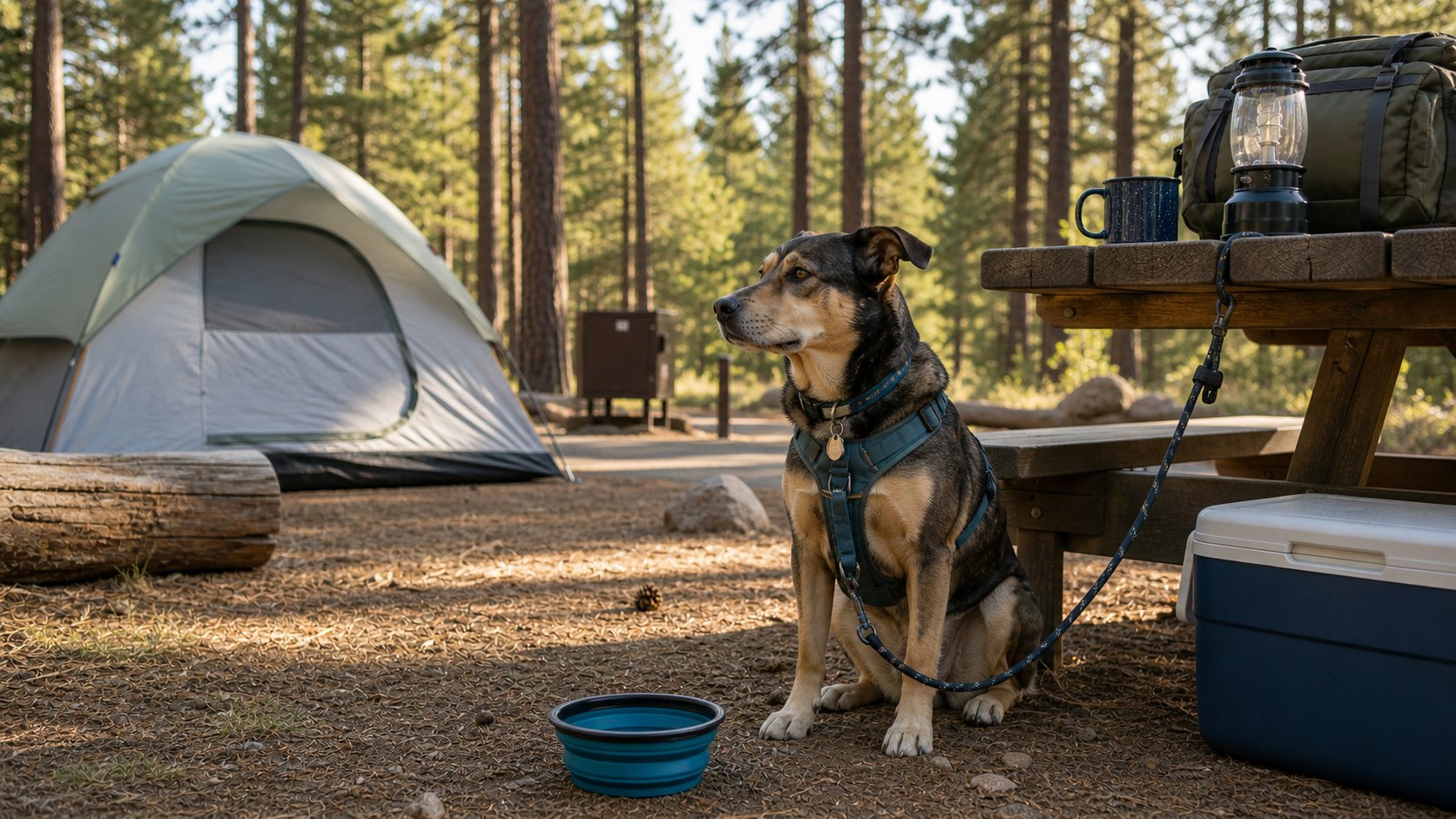
Camping with a dog goes better when you plan around rules before gear. Confirm that the campground allows dogs, read the leash and unattended-pet rules, pack enough water and dog supplies, and have a plan for heat, ticks, wildlife, waste and barking before you arrive.
This checklist is written for US campers planning developed campgrounds, car camping and road-accessible public-land trips. It is research-only, includes no affiliate links, and does not claim that Trail Gear Review personally tested any dog gear, campground or pet routine.
Quick Checklist Before Camping With a Dog
Use this first pass before you book or pack:
- Confirm the campsite or campground is pet-friendly for your dates.
- Read the pet section on the official campground, park or reservation page.
- Check leash length, tether, crate, unattended-pet and dog-limit rules.
- Verify trail, beach, building, shuttle and visitor-center restrictions.
- Save pet rules, reservation details and weather information for offline access.
- Make sure ID tags, microchip details and vaccination or health paperwork are current where required.
- Pack leash/restraint gear, waste bags, food, water, bowls, medication, bedding and a towel.
- Plan shade, water and cooling for warm weather.
- Check your dog for ticks after outdoor time and ask your veterinarian about prevention.
- Keep dog food, treats and waste controlled under local wildlife and sanitation rules.
For the human side of the trip, pair this with Trail Gear Review’s weekend camping checklist for beginners.
Check Pet Rules Before You Book
Do not assume “pet-friendly” means your whole plan is allowed. Recreation.gov says pet rules vary by campground and recommends checking the specific campground details before heading out. Some campgrounds allow dogs on the site but restrict trails, beaches, buildings, shuttles, off-leash areas, dog limits or unattended pets.
National Park Service sites often use the B.A.R.K. framework: bag pet waste, always leash pets, respect wildlife and know where pets can go. That is a useful starting point, but individual parks still set their own rules. Yosemite, for example, limits where pets may go and says pets must be restrained on a leash or otherwise physically restrained.
BLM guidance for hikers with dogs also points readers back to local trail pages or field offices for leash policy. The practical takeaway is simple: the exact place controls the rule. A dog-friendly campground does not automatically make every nearby trail, beach or public-land road dog-friendly.
Pet Rule Questions to Verify
Before booking, check these details on the official page or with the managing office:
- Are dogs allowed in this campground, loop and site type?
- Is there a limit on number of dogs per site?
- Is a six-foot leash required, or does the campground set another restraint rule?
- Are tie-outs, pens, dog fences or crates allowed at the site?
- Can dogs be left unattended at the campsite, in an RV or in a vehicle?
- Are dogs allowed on nearby trails, beaches, boat ramps, shuttles and day-use areas?
- Are service-animal rules listed separately from pet rules?
- Are there quiet hours, barking rules or nuisance-pet rules?
- Are there food-storage rules that include pet food, treats and bowls?
- Are current closures, wildlife advisories, heat alerts or harmful algal bloom warnings posted?
If you rely on an app during the trip, save the official rules where you can see them offline. Trail Gear Review’s guide to camping apps for planning, weather and offline maps can help with that planning workflow, but the official land-manager or campground page should remain the final rule source.
Prepare Health, ID and Travel Basics
Dog-camping prep starts before the gear pile. FDA pet-travel guidance recommends checking whether travel requires proof of vaccination or a health certificate, and it encourages identification such as tags or a microchip. For camping, that means your dog’s collar tag should be readable, contact information should be current, and any medication or veterinary instructions should be packed early.
This article is not veterinary advice. If your dog is very young, older, heat-sensitive, recovering from illness, anxious around other dogs, or new to long outdoor days, ask your veterinarian what precautions make sense before the trip.
Pack a small dog information card or phone note with:
- your name and phone number;
- campsite number and campground name;
- veterinarian contact information;
- current medications and doses;
- vaccine or health paperwork required by the destination;
- microchip number or registry information, if available.
A temporary tag with the campsite number can also help if a dog slips a collar or gets separated inside a campground. Keep the main permanent ID on the dog too.
Set Up a Dog-Safe Campsite
At camp, the goal is control without chaos. A calm dog routine protects your dog, nearby campers and wildlife. Keep your dog close, use the restraint method allowed by the campground, and do not leave your dog unattended while you go exploring.
Recreation.gov warns that a dog left alone at a campsite or in a vehicle can become wet, overheated, lonely, scared or noisy. Yosemite’s pet rules also say pets may not be left unattended. Even a well-behaved dog at home can bark, pull, chew, panic or react to unfamiliar people, dogs, bikes, wildlife and campground noise.
Set up the dog area intentionally:
- Choose shade and airflow first, not just a convenient spot.
- Keep the dog out of vehicle lanes, cooking areas and neighboring campsites.
- Use a leash, tether, crate or pen only if the campground allows that setup.
- Keep the leash short enough that the dog cannot reach passing campers, dogs or wildlife.
- Place water where it will not tip over easily.
- Keep food and treats closed except at feeding time.
- Pick up waste immediately and dispose of it in the proper trash location.
- Bring the dog inside your tent, vehicle setup or RV at night only if that is safe, legal and comfortable for the dog.
For shared-space planning, the article on how to camp when campgrounds feel too crowded is a useful companion. Dogs add noise, leash and neighbor considerations to an already shared environment.
Plan for Heat, Ticks and Unsafe Water
Heat is one of the easiest dog-camping risks to underestimate. FDA warns not to leave pets alone in a parked vehicle and cites an American Veterinary Medical Association estimate that an 80 F vehicle can reach 114 F in 30 minutes. Cracked windows are not a reliable safety plan.
For warm-weather trips:
- Avoid making arrival, setup or hiking happen during the hottest part of the day.
- Pick a shaded site where possible.
- Bring more water than your normal human-only trip.
- Offer water often instead of waiting for visible distress.
- Keep your dog off hot ground when possible.
- Have an exit plan to shade, cooling or home if the dog is not coping.
Trail Gear Review’s hot-weather camping checklist covers broader heat planning for the whole campsite.
Ticks are another practical concern. CDC recommends checking pets for ticks daily, especially after outdoor time, removing ticks right away, and talking with a veterinarian about the best tick-prevention products and local tickborne disease risks. Do not apply tick products intended for one animal or situation without veterinary guidance.
Water also needs a safety check. CDC says harmful algal blooms can harm animals, and animals may be exposed by drinking contaminated water, eating algae, licking it from fur, or having skin and eye contact. If your dog enters water with a possible cyanobacterial bloom, CDC recommends washing the animal with clean water to reduce licking exposure and calling a veterinarian if signs appear.
When in doubt, keep the dog out of questionable lake, pond or river water. Bring clean drinking water instead of relying on natural sources.
Keep Wildlife, Food and Waste Under Control
Dogs can change a campsite’s wildlife risk. NPS B.A.R.K. guidance emphasizes respecting wildlife, and multiple NPS pet pages note that dogs can disturb animals. Even if your dog never chases anything, scent, barking, food and waste can affect the area around camp.
Use these rules as the baseline:
- Never let a dog approach wildlife.
- Do not allow off-leash roaming.
- Pick up waste and dispose of it properly.
- Do not leave filled food bowls or treat bags out.
- Store dog food with the same seriousness as human food where wildlife rules apply.
- Follow bear-country, raccoon-country and rodent-control rules from the campground.
- Keep the dog away from carcasses, fish remains, dead animals and unknown scat.
Yosemite’s pet rules specifically tell visitors to store pet food in food lockers. Not every campground uses the same food-storage system, but the principle travels well: pet food is still food. If local rules tell you to store food, scented items or trash a certain way, include dog food, treats, chew items and waste in that plan unless the land manager says otherwise.
Dog Camping Gear Checklist
This is a practical checklist, not a ranked buying guide. Adjust it for your dog, weather, destination and veterinarian guidance.
Rule and ID Items
- Printed or saved campground pet rules.
- Reservation details and campsite number.
- Collar with current ID tag.
- Leash that meets the campground’s length rule.
- Backup leash or collar.
- Harness if that is how your dog is safely controlled.
- Proof of vaccination or health certificate if required for travel or lodging.
- Recent photo of your dog in case you need to describe them.
Food, Water and Comfort
- Dog food for the full trip plus delay margin.
- Treats packed in a wildlife-safe storage plan.
- Clean drinking water for the dog.
- Food and water bowls.
- Bedding, mat or blanket.
- Towel for rain, mud or rinsing after questionable water exposure.
- Weather-appropriate layer if your dog normally needs one.
- Brush or comb if burrs, ticks or debris are likely.
Campsite Control and Cleanup
- Waste bags, more than you expect to need.
- Approved tether, crate or pen only if the campground allows it.
- Light or reflective item for evening visibility.
- Dog-safe cleaning supplies for bowls and messes.
- Trash plan for waste bags and food packaging.
Health and Emergency
- Dog medications and written instructions.
- Veterinarian contact information.
- Basic first-aid items appropriate for your dog and trip.
- Tick-removal tool or method recommended by your veterinarian.
- Paw check routine for cuts, burrs, thorns or irritation.
- Emergency route to the nearest veterinary care where practical.
Do not let the checklist become a reason to overbuy gear. Start with rule compliance, restraint, water, food, ID, waste cleanup, safety and comfort. Add optional items only when they solve a real problem for your dog and destination.
When Leaving the Dog Home Is the Better Plan
A dog-friendly trip is not always dog-appropriate. Leaving the dog home with a trusted sitter, boarding option or family member may be the better plan when the rules, weather or activities do not match the dog.
Consider skipping the dog if:
- the campground allows dogs but the main trails, beaches or activities do not;
- the forecast includes extreme heat and shade or cooling is uncertain;
- harmful algal bloom warnings affect the water activities you planned;
- the dog is highly reactive to people, dogs, bikes or wildlife;
- the dog cannot be supervised because the group has long no-pet activities;
- health paperwork, medication or ID is not ready;
- food-storage or wildlife rules would be hard to manage safely;
- the trip would require leaving the dog alone in a vehicle, tent, RV or campsite.
That is not a failure of planning. It is the decision that keeps the dog, other campers and the destination safer.
Sources and Method
This article uses official campground, government, public-health and veterinary sources. It does not include affiliate links, product rankings, personal campsite experience or unsourced veterinary claims.
- Recreation.gov: Top Tips for Camping with a Dog
- National Park Service: B.A.R.K. Ranger principles
- National Park Service: Pets in Yosemite
- Bureau of Land Management: Hiking with Dogs
- FDA: Traveling with Your Pet
- CDC: Preventing Ticks on Pets
- CDC: Preventing Pet and Livestock Illnesses Caused by Harmful Algal Blooms
- AVMA: Pet Safety in Vehicles
- Recreation.gov: Payson Lakes Campground important notices
- Leave No Trace: Minimize Pet Impacts in the Outdoors