

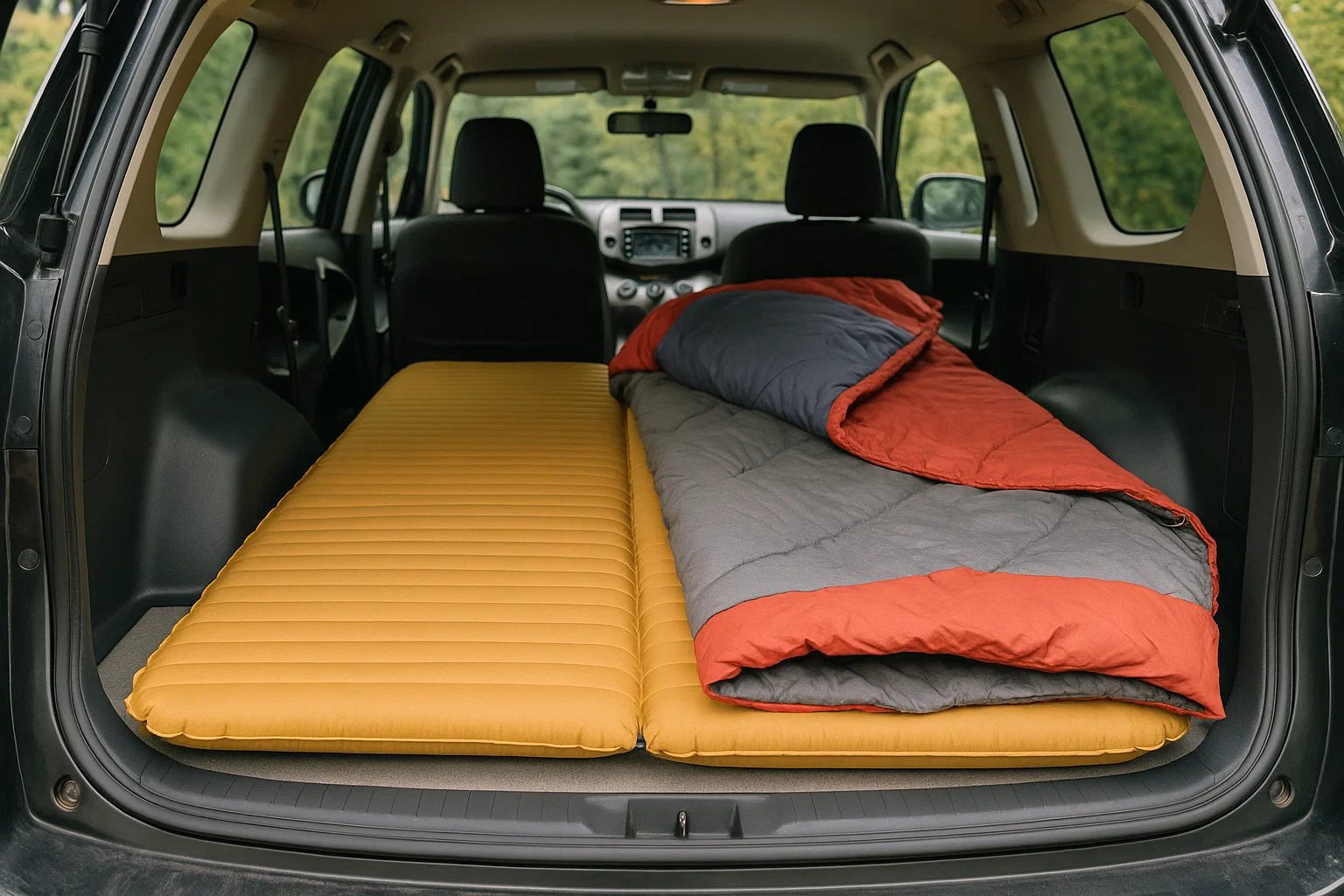
The best car camping sleeping pad for most vehicle-based trips is a thick self-inflating or foam-and-air camp mat that fits your vehicle, has enough width for your sleep style, and carries a realistic R-value for the coldest nights you expect. This refresh is research-based, not a hands-on product test, and it does not include affiliate links.
If you are sleeping in an SUV, crossover, van, truck bed or tent near the vehicle, choose the pad like part of a sleep system. Match the pad to your sleeping bag, the flat space you actually have, the way you sleep, and whether the trip is a warm weekend campground stay or a colder overlanding route.
Quick Answer: The Best Car Camping Sleeping Pad Setup
For car camping and overlanding, start with fit, comfort and warmth before brand names. REI’s sleeping pad guidance notes that self-inflating pads are often good car-camping choices because they are extra comfortable, while ASTM F3340 gives shoppers a standardized way to compare camping-mattress thermal resistance.
For most readers, the practical answer is:
| Camper need | Research-based fit | Why it makes sense |
|---|---|---|
| One person in an SUV, tent or truck bed | A wide self-inflating pad around 4 inches thick | More width and foam support matter more than ultralight pack size. |
| Two people or a wide vehicle platform | A double or queen-size camp mattress | Reduces the gap between two single pads and uses vehicle space efficiently. |
| Cold shoulder-season trips | A pad with a higher ASTM-tested R-value | A higher R-value indicates more thermal resistance, but clothing, bag choice and campsite exposure still matter. |
| Small vehicle with limited storage | A single or single-wide foam-air pad with a manageable packed size | Easier to move between the vehicle, tent and storage bin. |
| Long road trips | A durable, rectangular pad with easy inflation and deflation | Repeated setup favors comfort, stable edges and low-friction packing. |
The current live article should be updated because it relies on affiliate links, rough prices and unsupported product language. The refreshed version should help readers compare specs without implying that Trail Gear Review personally tested the pads.
Quick Picks by Vehicle and Sleep Style
Use these picks as starting points, not absolute rankings. The source trail here comes from manufacturer or major retailer product specifications available on June 3, 2026.
| Research-based pick | Best fit | Key sourced specs | Main tradeoff |
|---|---|---|---|
| Exped MegaMat Duo 10 | Couples, wide SUV platforms, vans and roomy truck-bed setups | Exped lists an 8.1 R-value, 4-inch thickness and Duo sizes up to queen dimensions. | Large packed size and heavy weight compared with single pads. |
| NEMO Roamer | Campers who want single, wide or double options with strong warmth | NEMO lists a 7.0 R-value, 4-inch thickness and single through double-wide sizes. | Less compact than backpacking pads. |
| Sea to Summit Comfort Deluxe SI | Comfort-focused car camping, overlanding and van-life use | Sea to Summit lists car camping/overlanding/van life as best uses, 3.9-inch thickness and 7.7 R-value. | Double size is bulky and heavy. |
| REI Co-op Camp Dreamer XL | One-person value-oriented car camping | REI lists a 6.6 R-value, 4-inch thickness and 78 x 30 x 4 inch dimensions. | One XL pad may be too wide for some narrow vehicle layouts. |
| Therm-a-Rest MondoKing 3D | One-person comfort with high insulation | REI lists a 7.0 R-value and 4.25-inch thickness for the current MondoKing 3D. | Premium, bulky camp-mattress category rather than backpacking gear. |
If you are building a full sleep kit, pair this decision with a suitable sleeping bag. Trail Gear Review’s guide to a sleeping bag for camping and overlanding explains why the bag and pad should be chosen together.
How to Choose a Sleeping Pad for Car Camping
A good sleeping pad for car camping should solve four problems: cushioning, insulation, fit and repeatable setup. Unlike backpacking, vehicle-based camping usually lets you accept more weight and packed volume in exchange for comfort and width.
Start with your actual sleep space. Measure the flat area in the vehicle, tent, truck bed or platform before comparing pads. Check length, width, wheel-well intrusion, seat hinges, storage boxes and whether the tailgate or hatch will close. A pad that looks perfect online can be frustrating if it overlaps a console, cargo bin or wheel well.
Then compare these specs:
- Width: side sleepers and restless sleepers often benefit from wide pads, but narrow vehicles may not allow two wide singles.
- Thickness: many comfort-focused car-camping pads are around 4 inches thick, which helps reduce pressure points compared with thin backpacking pads.
- R-value: the higher the R-value, the more thermal resistance the pad provides under standardized testing, but it is not a guarantee of comfort in every condition.
- Shape: rectangular pads usually use vehicle space better than mummy-shaped backpacking pads.
- Packed size: less important than backpacking, but still important in small SUVs, crossovers and road-trip builds.
- Inflation method: self-inflating foam pads often need topping off, and repeated trips favor simple valves and a realistic packing process.
If you are also building a first camping kit, see Trail Gear Review’s beginner camping gear checklist before spending all of your budget on sleep comfort alone.
Research-Based Sleeping Pad Notes
These product notes are based on sourced specs, not personal testing. They are included because the live article already names specific sleeping pads and the refresh needs to replace unsupported claims with verifiable comparisons.
Exped MegaMat Duo 10
The Exped MegaMat Duo 10 is the best fit in this set for couples or campers with a wide sleep platform. Exped lists the pad at 4 inches thick with an 8.1 R-value and sizes that include medium, long-wide-plus and queen. The queen version is listed at 80 x 59.8 x 4 inches, which makes it closer to a vehicle mattress than a compact trail pad.
Choose this style if your SUV, van or truck setup has the floor space and you want one continuous sleeping surface. Skip it if storage volume, weight or fast solo setup matter more than a wide bed-style layout.
NEMO Roamer
The NEMO Roamer is useful for campers who want the same general pad family in single, single-wide, double or double-wide sizes. NEMO lists a 7.0 R-value and 4-inch thickness across the Roamer line, with packed sizes that scale from a smaller single roll to a larger double-wide roll.
That makes the Roamer a flexible option for people who change between tent camping, SUV sleeping and occasional two-person vehicle setups. It is still a car-camping mattress category, so it should not be treated like a compact backpacking pad.
Sea to Summit Comfort Deluxe SI
Sea to Summit positions the Comfort Deluxe Self-Inflating Sleeping Pad for overlanding, car camping and van life. The current product page lists a 7.7 R-value, 3.9-inch thickness and rectangular sizes including regular wide, large wide and double.
This is a strong research-based candidate when comfort and warmth matter more than carrying weight. The double version is a large camp mattress, so measure your vehicle platform before assuming it will fit.
REI Co-op Camp Dreamer XL
The REI Co-op Camp Dreamer XL is a one-person self-inflating deluxe bed with sourced specs that fit the car-camping brief: REI lists a 6.6 R-value, 4-inch thickness, 78 x 30 x 4 inch dimensions and 6 lb. 6 oz. weight.
It makes sense for solo car campers who want a wide rectangular pad without moving into two-person mattress size. The width is helpful for comfort, but it may be too much for tight back-seat or narrow cargo-area layouts.
Therm-a-Rest MondoKing 3D
The current Therm-a-Rest MondoKing 3D listing at REI gives the pad a 7.0 R-value and 4.25-inch thickness. That combination puts it in the thick, warm, one-person car-camping category rather than the ultralight category.
Consider this style if you want a single pad with substantial cushion and insulation. As with the other premium self-inflating pads, the main tradeoff is bulk.
Can You Use a Camping Sleeping Pad in a Car or Truck Bed?
Yes, you can use a camping sleeping pad in a car, SUV or truck bed if the pad fits the flat sleeping area and the vehicle setup is safe for overnight use. Measure the space first, flatten or bridge uneven surfaces, and do not run a vehicle engine, fuel-burning heater, stove or grill in an enclosed sleeping area.
For vehicle sleeping, the fit questions matter more than the product name:
- Is the sleeping surface long enough for your body and pillow?
- Is the floor flat, or do folded seats create pressure points?
- Does the pad fit between wheel wells or storage bins?
- Can doors, hatch or tailgate close safely if needed?
- Is there ventilation appropriate for the conditions?
- Is food stored according to local campground or public-land rules?
The CDC warns that carbon monoxide is odorless and colorless and can cause sudden illness or death. Treat that as a hard boundary: do not use combustion gear inside a vehicle or enclosed shelter, and follow current safety guidance for heaters, stoves and generators.
For overlanding routes on public land, sleep setup is only one part of the plan. Trail Gear Review’s guide to planning an overlanding route on public lands covers route, land-manager and fallback planning that should happen before a remote overnight.
R-Value, Warmth and Sleep-System Fit
R-value is a measure of thermal resistance. ASTM F3340 is the standard test method for thermal resistance of camping mattresses, and the measured value is intended to help compare and select mattresses. In simple terms, a higher R-value means the pad resists heat transfer better than a lower-R-value pad under the test method.
For car camping, do not choose by R-value alone. A warm pad can still feel uncomfortable if it is too narrow, too short or sitting on an uneven folded-seat gap. A warm sleeping bag can also underperform if the pad below it is too thin or poorly matched to the weather.
A practical sleep-system check looks like this:
- Choose the coldest realistic overnight low for the trip.
- Pick a sleeping bag or quilt with enough margin for that low.
- Choose a pad with enough R-value for the season and ground/vehicle surface.
- Add dry sleep clothes and a backup layer for shoulder-season trips.
- Test the full setup at home before a remote route.
If you rely on apps for forecast, route or offline map planning, Trail Gear Review’s guide to camping apps for planning and offline maps can help you build a basic planning stack.
Final Checklist Before You Buy
Before buying a sleeping pad for car camping or overlanding, measure first and compare second. The best spec sheet is still wrong for you if the pad does not fit your actual vehicle, sleep style or storage space.
Use this checklist:
- Measure the usable sleep length and width in your vehicle or tent.
- Decide whether you need one wide single, two singles, a double or a queen-style pad.
- Check thickness and whether the pad will clear the hatch, platform or storage boxes.
- Compare R-value using sourced specs, preferably ASTM-tested values.
- Confirm packed size if the pad must live in a small SUV or crossover.
- Avoid relying on approximate prices unless you verify them the day you buy.
- Skip affiliate-style urgency and choose around your actual trip conditions.
- Keep the sleeping pad, bag, weather layers and ventilation plan together as one sleep system.
Sources and Method
This refresh is a research-only update for Trail Gear Review. It replaces affiliate links and unsupported product blurbs with sourced product specifications, official safety guidance and a practical decision framework. It does not claim that Trail Gear Review personally tested these pads.