

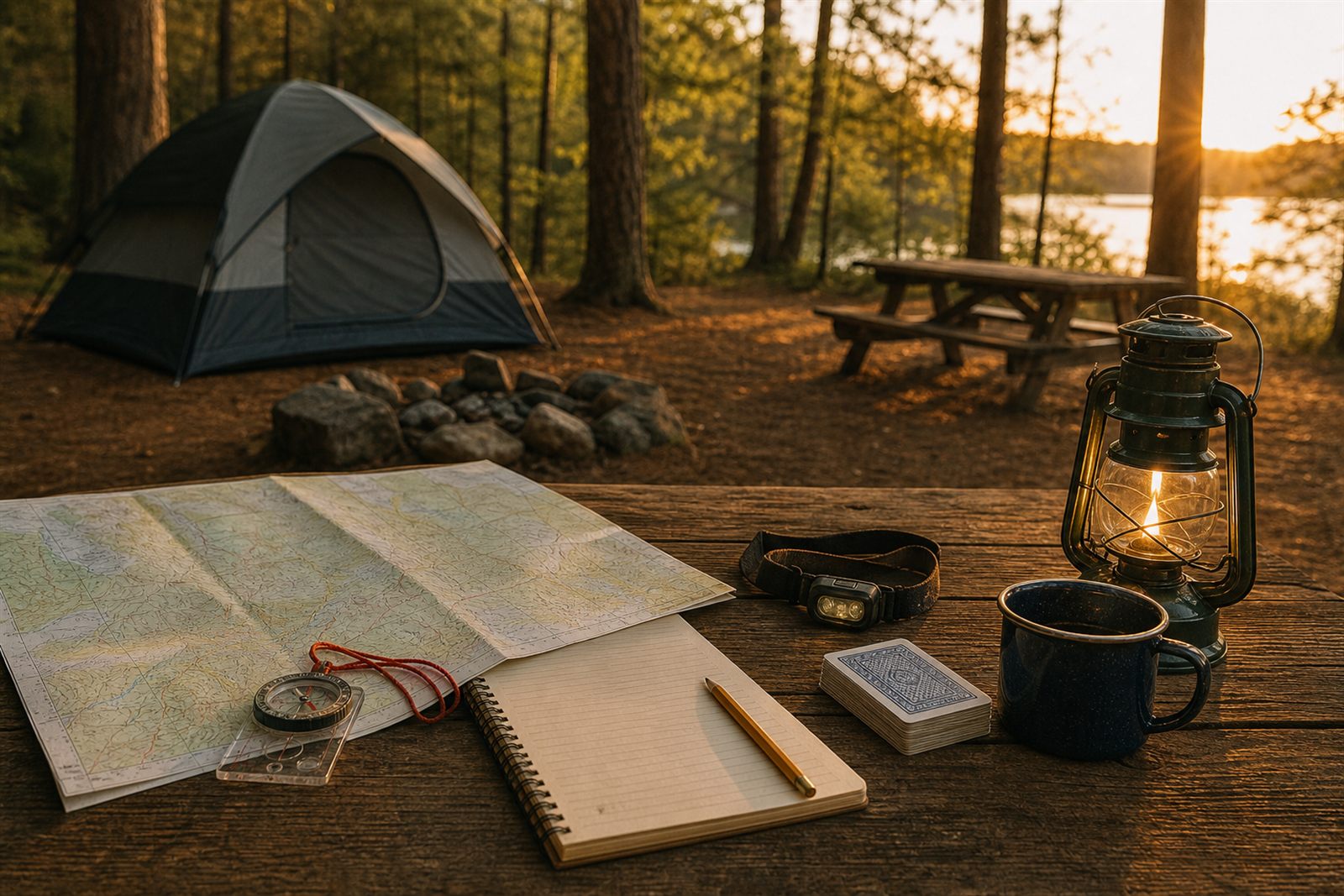
Analog camping works best when you make the phone less central without pretending it has no safety value. The practical goal is simple: put key trip details on paper, download what you need before leaving service, build easy camp routines, bring offline entertainment and keep weather, navigation, food, fire and emergency checks in the plan.
This guide is written for US campers planning a campground or car-camping weekend. It is research-only, uses no affiliate links and does not claim that Trail Gear Review tested a specific campsite, method or product.
The Short Version: Go Analog-First, Not Phone-Free
A low-screen camping weekend should be analog-first, not reckless. Use paper, notebooks, maps, printed confirmations and simple routines for most of the trip. Keep the phone available for weather, emergency communication, offline maps, reservations and urgent alerts.
That balance matters because the same planning habits that reduce screen time also make a trip more resilient. The National Park Service’s Ten Essentials include navigation, illumination, first aid, fire, shelter and other emergency systems. A phone can support some of those jobs, but it should not be the only place your route, campsite details, weather plan and emergency notes live.
Think of the phone as a quiet tool. Prepare it before the trip, then let the weekend run mostly from the notebook, the printed map and the plan you already made.
Why Analog Camping Is Showing Up in 2026 Trip Planning
KOA’s 2026 Camping and Outdoor Hospitality Report release highlights “the rise of analog camping” and a shift toward unstructured outdoor wellness as part of the outdoor hospitality conversation. KOA’s 2026 report page also says over 52 million North American households camped in 2025, which gives this trend a broad camping context.
For Trail Gear Review readers, the useful takeaway is not that every trip needs a strict digital detox. It is that many campers want a weekend that feels less scheduled, less app-driven and more present. A good analog camping plan turns that idea into small, practical choices: fewer notifications, more paper backups, simple meals, slower mornings and activities that do not require a signal.
This article avoids health-outcome claims. It treats low-screen camping as a trip-planning preference, not a medical or wellness promise.
Before You Leave: Put the Important Details on Paper
Start with a one-page paper trip sheet. Put it somewhere easy to reach, such as the glove box, campsite folder or top of the camp bin. If your phone battery dies or service disappears, you should still know where you are going and what the backup plan is.
Write down:
- Campground name, address, loop, site number and check-in details.
- Reservation or permit confirmation number.
- Primary driving route and a backup route.
- Nearby ranger station, campground host, park office or land-manager contact.
- Emergency contact, vehicle plate and basic medical notes your group wants available.
- Weather notes, overnight low, storm risk and expected wind or heat.
- Fire, food-storage, pet, quiet-hour and trash rules for the campsite.
- A short departure and return plan to share with someone at home.
Pair that with printed or paper-map support. The NPS Ten Essentials include navigation such as a map, compass and GPS. For beginner campground trips, that may mean a road atlas, park map, campground map or printed driving directions rather than a full backcountry topo map. For higher-consequence routes, use Trail Gear Review’s guide to an offline navigation backup plan and match the backup to the trip.
If you are still building the basic gear list, start with the weekend camping checklist for beginners and add this analog layer on top.
Set Up Your Phone as a Quiet Safety Tool
The easiest mistake is to treat low-screen camping as a reason to skip digital preparation. Do the opposite. Prepare the phone carefully before leaving, then reduce casual use at camp.
Before departure:
- Download offline maps for the campground, route, nearby towns and bailout roads.
- Save reservation confirmations, permits and check-in details for offline access.
- Screenshot campground rules, fire restrictions, food-storage notes and gate codes if provided.
- Check Weather.gov or the relevant National Weather Service forecast.
- Charge the phone and battery pack.
- Turn off nonessential notifications.
- Keep emergency alerts and important contacts available.
- Tell your group when phone use is for safety, logistics, photos or true downtime.
The National Weather Service’s outdoor flood guidance for camping and hiking advises checking the forecast before outdoor trips and avoiding low ground near streams when flood risk exists. That is a good example of why the phone should stay available as a tool. A calm low-screen weekend still needs weather awareness.
For a more app-focused planning workflow, use Trail Gear Review’s guide to camping apps for planning and offline maps before you leave, then put the phone away once the essentials are saved.
Build a Simple Camp Routine That Does Not Need a Feed
Analog camping gets easier when the campsite has a rhythm. Without one, people often reach for phones during every small gap. Keep the routine simple enough that it feels natural, not like a schedule.
Try this structure:
- Arrival: Set up shelter, water, food storage, trash plan and lighting before relaxing.
- First evening: Cook, clean up, review the next day’s weather and choose one low-screen activity.
- Morning: Make coffee or breakfast, check the weather once, then keep phones away during the slow part of the morning.
- Midday: Hike, swim where legal and safe, read, play cards, sketch, cook or explore the campground.
- Evening: Reset camp, secure food and trash, prep headlamps, then use lantern light instead of screen light.
- Departure: Do a full camp sweep for trash, food scraps and forgotten gear.
This routine also supports responsible camping. The NPS version of the Leave No Trace Seven Principles includes planning ahead, camping on durable surfaces, disposing of waste properly, minimizing campfire impacts, respecting wildlife and being considerate of other visitors. A calmer campsite should also be a cleaner, quieter and lower-impact campsite.
For a deeper campsite-impact checklist, link this plan with Trail Gear Review’s Leave No Trace camping checklist.
Pack Analog Entertainment That Fits the Campsite
Offline entertainment should be small, durable and realistic for the people going. Do not pack a crate of activities if you only need a few options for a two-night weekend.
Good analog choices include:
- A deck of cards.
- A compact board game or travel game.
- A paperback book or field guide.
- A notebook and pencil.
- A printed nature scavenger list for kids.
- Binoculars for distant wildlife viewing.
- A star chart or printed moon/constellation notes.
- A simple camp recipe card.
- A small repair or knot-practice kit.
Keep the campsite context in mind. Bright lights, loud games and late noise can affect other campers. “Low-screen” should not become “high-disruption.” If you are in a developed campground, quiet hours, neighbor distance and local rules still apply.
Keep Safety Checks in the Plan
Water
NPS camping guidance describes water as an important survival need and notes that campers need it for drinking, cooking and cleaning. For frontcountry camping, plan how you will fill and store water. For backcountry or uncertain water sources, NPS guidance says water must be filtered, purified or boiled before drinking or food preparation.
Food Storage and Food Safety
NPS camping guidance tells campers to check specific food-storage policies and keep food contained and clean so animals do not get into it. Its cooking-in-camp guidance also emphasizes that food storage matters for people and wildlife.
USDA FSIS outdoor food-safety guidance supports planning meals and equipment ahead, using a cooler or cold source for perishable food, keeping raw foods separate and using soap and water or hand sanitizer before and after handling food. A low-screen weekend can use simple meals, but it should not skip safe food handling.
Weather and Flood Risk
Check the forecast before leaving and again close to departure. The National Weather Service warns that flash floods can occur quickly in hilly terrain and advises campers not to camp on low ground next to streams when flood risk exists. This is especially important for waterfront campsites, canyon areas, desert washes and stormy weekends.
Fire
Do not make a campfire automatic. NPS campfire guidance tells campers to confirm whether fires are permitted and follow local rules. If restrictions change, switch to a stove where allowed or a no-fire evening routine. Never treat an analog camping mood as permission to ignore fire conditions.
Navigation and Light
Carry a map or printed route reference, a way to know where you are and enough light to move around camp after dark. The NPS Ten Essentials include both navigation and illumination. A headlamp, spare batteries or charged lighting plan can matter even in a developed campground.
The Analog Camping Checklist
Use this list after the article planning is done.
Paper and Planning
- Print or write your campground name, address, site number and confirmation.
- Write a short route plan and backup route.
- Carry a campground, park, road or trail map that fits the trip.
- Write down weather notes, fire rules, food-storage rules and water availability.
- Share your destination and return plan with someone at home.
Phone Setup
- Download offline maps.
- Save reservations, permits and rules for offline access.
- Check Weather.gov or the relevant NWS forecast before leaving.
- Charge the phone and power bank.
- Turn off nonessential notifications.
- Keep emergency alerts and important contacts available.
Camp Routine
- Set up shelter, water, food storage, trash and lighting before relaxing.
- Pick one or two phone-check windows if the group wants them.
- Keep phones away during meals, games and morning coffee unless needed.
- Store food, trash and scented items according to local rules.
- Do a final camp sweep before checkout.
Analog Entertainment
- Pack cards, a book, notebook, pencil or compact game.
- Bring a printed activity list for kids if useful.
- Use a lantern or headlamp instead of screen light.
- Keep noise and lights considerate of nearby campers.
Safety
- Bring water storage and a water-treatment plan if needed.
- Pack food so perishables stay cold and raw foods stay separate.
- Check fire restrictions and skip fires where they are not allowed.
- Avoid low streamside ground when flood risk exists.
- Keep first aid, illumination, shelter and navigation basics accessible.
Bottom Line
Analog camping is not about proving you can camp without technology. It is about moving the weekend’s center of gravity away from screens and back toward the campsite, the people you came with and the place you came to enjoy.
The safe version is simple: prepare the phone before you leave, keep it available for weather and emergencies, then run most of the trip from paper backups, simple routines and offline activities. That gives you the low-screen weekend you wanted without removing the safety checks that good camping still depends on.