

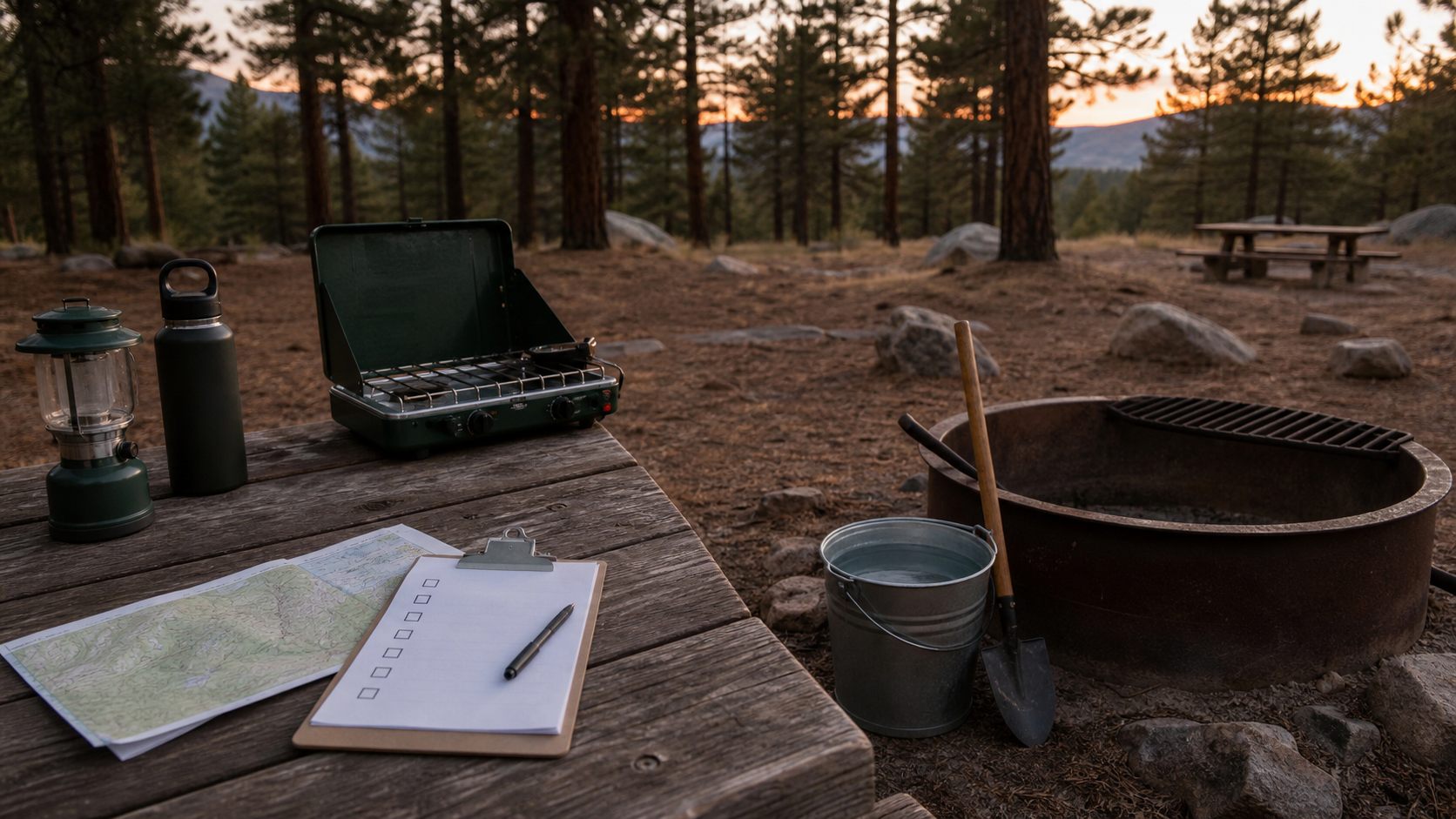
You can have a campfire only when the current rule for your exact campsite allows that fire type, the weather and fire danger are acceptable, you have a legal fire ring or fire area, and you can keep the fire attended and extinguish it completely. If any part is unclear, treat the answer as no and use a stove or no-fire evening plan instead.
This checklist is written for US campers. It is research-only, uses no affiliate links, and does not claim that Trail Gear Review tested a campsite, stove, campground, fire ring or fire-safety method. Fire restrictions can change quickly, so use this article as a decision workflow and verify the current rule from official sources before every trip.
The Short Answer: Only Light a Fire After These Checks Pass
Before you light anything, four things must be true. The land manager or campground must allow campfires for your exact location. The current restriction order must allow the fuel type you want to use, such as wood, charcoal or a stove. Weather and fire danger must not make an open flame a bad idea. You must have enough water, tools and time to put the fire out until it is cold.
The National Park Service tells campers to know local rules and current fire conditions before starting a fire. That is the right starting point even when you are not in a national park. Campfire permission is local. A fire that was allowed on your last trip, in another campground, or earlier in the season may not be allowed today.
The conservative rule is simple: if you cannot confirm permission from an official current source, do not light a campfire.
Step 1: Identify Who Controls the Campsite
The first question is not “Do people have fires here?” It is “Who controls this campsite, road, beach, forest, park or campground?”
Start with the land manager:
- National Park Service site or campground
- USDA Forest Service forest, ranger district or campground
- Bureau of Land Management field office or public-land area
- state park, county park or city campground
- private campground or RV park
- tribal, private or leased land with its own rules
Then check the campground page, reservation page, posted signs and any ranger or host instructions. A developed campground may have different rules from nearby dispersed camping. A picnic area may allow a fire in a grate while a backcountry site does not. A beach, wilderness area, desert road or trailhead may have rules that do not match the campground next door.
If you are building your broader trip plan, pair this check with a weekend camping checklist so fire rules, water, food storage, lighting and weather checks are handled before you leave home.
Step 2: Check Current Fire Restrictions the Same Day
Fire restrictions are time-sensitive. Check them when planning the trip, then again shortly before departure, and again at the campground if signs, hosts or alerts have changed.
Use official sources first:
- the park, forest, BLM field office, state park or campground alerts page
- the campground reservation page or arrival packet
- BLM regional fire restriction pages for BLM-managed public lands
- Forest Service alerts and local forest orders for National Forest land
- NPS park alerts, campground pages and posted rules for national parks
- county or local burn-ban pages when the campground tells you those rules apply
- the National Interagency Fire Center fire information page and InciWeb links for current wildfire awareness
BLM says fire restrictions or temporary public-land closures may be used to reduce wildfire risk and protect the public, and it directs visitors to check regional restrictions before heading out. NIFC is useful for national fire awareness, maps and incident information, but it should not be treated as a blanket permission slip. Local restrictions and campground rules still control the fire decision.
If cell service may be weak, save official restriction pages, campground rules and weather details before the trip. Trail Gear Review’s guide to camping apps for planning and offline maps and its offline navigation backup plan can help keep those details available when service drops.
Step 3: Read What the Restriction Actually Bans
“Fire ban” is not specific enough. Read the actual restriction language. It may treat wood fires, charcoal, twig stoves, propane stoves, lanterns, smoking, generators, vehicles, target shooting and welding differently.
Look for these details:
- Is a wood campfire allowed?
- Is charcoal allowed?
- Are fires limited to developed campgrounds?
- Are fires limited to metal fire rings or park-provided grates?
- Are dispersed campfires prohibited?
- Are gas or propane stoves allowed?
- Does a stove need a shut-off valve?
- Is a permit required for any open flame or stove?
- Are smoking, vehicle, generator or equipment rules part of the same order?
- Does the rule apply by elevation, campground, district, county or date?
Agency examples show why the details matter. Some Forest Service and NPS restriction pages allow gas or propane stoves when wood or charcoal fires are restricted. Other restriction stages can be stricter. Some places require a permit, a shut-off valve, a developed site or a specific fire ring.
Do not assume that a propane stove, charcoal grill, portable fire pit or twig stove is allowed just because it is not a traditional campfire. Check the wording for your location.
Step 4: Check Wind, Dry Weather and Red Flag Conditions
A campfire can be a bad decision even when it appears legal. Wind, dry vegetation, heat, low humidity and active wildfire conditions can all raise the risk.
Check the National Weather Service forecast and local alerts. NWS Red Flag and Fire Weather products are tied to critical weather and fuel conditions, and the specific criteria vary by area. For a camper, the practical takeaway is straightforward: if Red Flag conditions, strong winds, very dry fuels or nearby fire activity are in play, skip the open flame unless local authorities clearly say your exact fire type is allowed and safe.
Do a campsite-level wind check too. If sparks could blow toward tents, vehicles, dry grass, needles, brush, firewood, picnic shelters or neighboring sites, do not light the fire. NPS guidance tells campers to keep tents, gear and other flammable objects at least 15 feet away and upwind of the firepit. If your site cannot meet that basic spacing, the fire plan is not ready.
Step 5: Confirm the Fire Ring, Firewood and Water Plan
If the official rule allows a campfire, the next check is whether your actual campsite can support one.
Confirm:
- the fire is allowed in this specific site, not just in the broader campground
- the fire must be in a provided metal ring, grate or designated fire area
- the ring is clear of trash, plastic, food scraps and old packaging
- tents, chairs, gear, wood and vehicles are far enough from heat and sparks
- there is no overhanging brush or dry grass touching the fire area
- you have water ready before lighting, not after the fire is already burning
- you have a shovel, poker or tool for stirring and spreading coals
- someone responsible can attend the fire the whole time
NPS campfire guidance says campers should never leave a campfire unattended and should always keep water nearby. It also says firewood should be bought near the campground or collected locally only where rules permit, because bringing wood from far away can move pests.
That means the firewood check is part of the restriction check. Do not bring wood from another region unless the official rules allow it. Do not collect deadfall, branches or local wood unless the local rule says collection is permitted.
Step 6: Use a Stove or No-Fire Evening When the Answer Is No
When campfires are restricted, the best backup is a meal and evening plan that does not depend on a wood fire.
Possible alternatives include:
- a propane or gas camp stove, only if current rules allow it
- cold meals that do not require cooking
- pre-cooked meals kept safely cold and reheated only if a stove is allowed
- a lantern, headlamp or string light setup instead of firelight
- cards, reading, stargazing or a short evening walk where safe and legal
- a campground program or quiet hour routine
The Forest Service says portable stove areas should be clear of grasses and debris and that stoves should be prevented from tipping. Treat a stove as a controlled flame, not a loophole. Keep it stable, attended and away from flammable material. If a restriction says no stoves, no open flame, or no gas appliances, choose a no-cook plan.
This is a good place to connect fire rules with broader campsite impact. Trail Gear Review’s Leave No Trace camping checklist can help build a cleaner low-impact camp routine when a fire is not appropriate.
Step 7: If a Fire Is Allowed, Keep It Small and Attended
If every check passes, keep the fire smaller than the ring can hold. A small cooking or evening fire is easier to control, easier to extinguish and less likely to throw sparks.
Do not use gasoline or improvised accelerants. Do not burn plastic, cans, glass, food packaging or trash. Do not leave children or pets unsupervised around the fire. Do not walk away “just for a minute.” NPS guidance is clear that fires should not be left unattended.
Keep extra firewood upwind and away from the ring. Watch for wind shifts. If gusts increase, smoke begins blowing into neighboring campsites, sparks are escaping the ring, or conditions feel less controlled than they did at lighting, put the fire out early.
Step 8: Put It Out Until It Is Cold
A fire is not out when the flames are gone. NPS guidance notes that white or gray coals can hold heat for hours and can flare up if wind gusts. The Forest Service says a campfire should be fully extinguished before leaving and cold to the touch.
Use this basic sequence:
- Let the wood burn down if you have time.
- Spread coals and ashes inside the fire ring.
- Douse the fire and coals with plenty of water.
- Stir the ash, coals and wet material thoroughly.
- Turn over larger pieces and wet all sides.
- Feel for heat cautiously before leaving.
- Repeat until the fire area is cold.
If water is not available, NPS says sand or dirt can be used in a pinch, but simply kicking dirt onto coals can insulate heat. Spread the coals and stir dirt or sand through them until they are extinguished. The better plan is to have enough water ready before the fire starts.
Do not go to sleep or leave the campsite while the fire ring is still warm.
Campfire Restrictions Checklist
Use this list before lighting a fire.
Official Rule Check
- Identify the land manager or campground owner.
- Check the current official fire restriction page for that exact area.
- Read campground signs, alerts, reservation details and host/ranger instructions.
- Confirm whether the rule applies today, not just earlier in the season.
- Check local county or state burn bans if the campground says they apply.
- Save the rule page before leaving service.
Fire Type Check
- Wood fire allowed?
- Charcoal allowed?
- Twig stove allowed?
- Propane or gas stove allowed?
- Shut-off valve required?
- Permit required?
- Only developed campgrounds allowed?
- Only provided metal rings or grates allowed?
- Any elevation, district, date or site-specific limits?
Weather and Site Check
- No Red Flag Warning or local fire-weather alert affecting your area.
- No strong wind or gusts that could push sparks out of the ring.
- No dry grass, needles, brush or low branches near the fire area.
- Tents, gear and flammable objects are at least 15 feet away and upwind.
- The fire ring is clean and not overloaded with ash or trash.
Wood, Water and Tool Check
- Firewood is local or legally collected where rules allow.
- Water is staged before lighting.
- Shovel, poker or stirring tool is ready.
- Someone responsible will attend the fire at all times.
- Extra wood is away from the ring and upwind.
No-Fire Backup Check
- Stove is allowed under current rules, or a no-cook meal is planned.
- Lantern or headlamp replaces firelight.
- Warm layers replace the idea of sitting close to flames.
- Evening activity does not depend on a campfire.
Extinguishing Check
- Fire is burned down, spread out and doused.
- Coals and ash are stirred thoroughly.
- Large pieces are turned and wet on all sides.
- The ring is cold before sleep or departure.
- No trash, food scraps, plastic, cans or glass are left in the ring.
Bottom Line
The safest campfire decision is local, current and conservative. Start with the land manager, read the actual restriction order, check weather and wind, confirm the fire ring and fuel rules, stage water and tools, and keep the fire small and attended.
If the rule is unclear, the weather is questionable, the site is not suitable, or you cannot put the fire out completely, do not light it. A stove or no-fire evening is still camping. It is also the better choice when the official answer is anything less than a clear yes.