

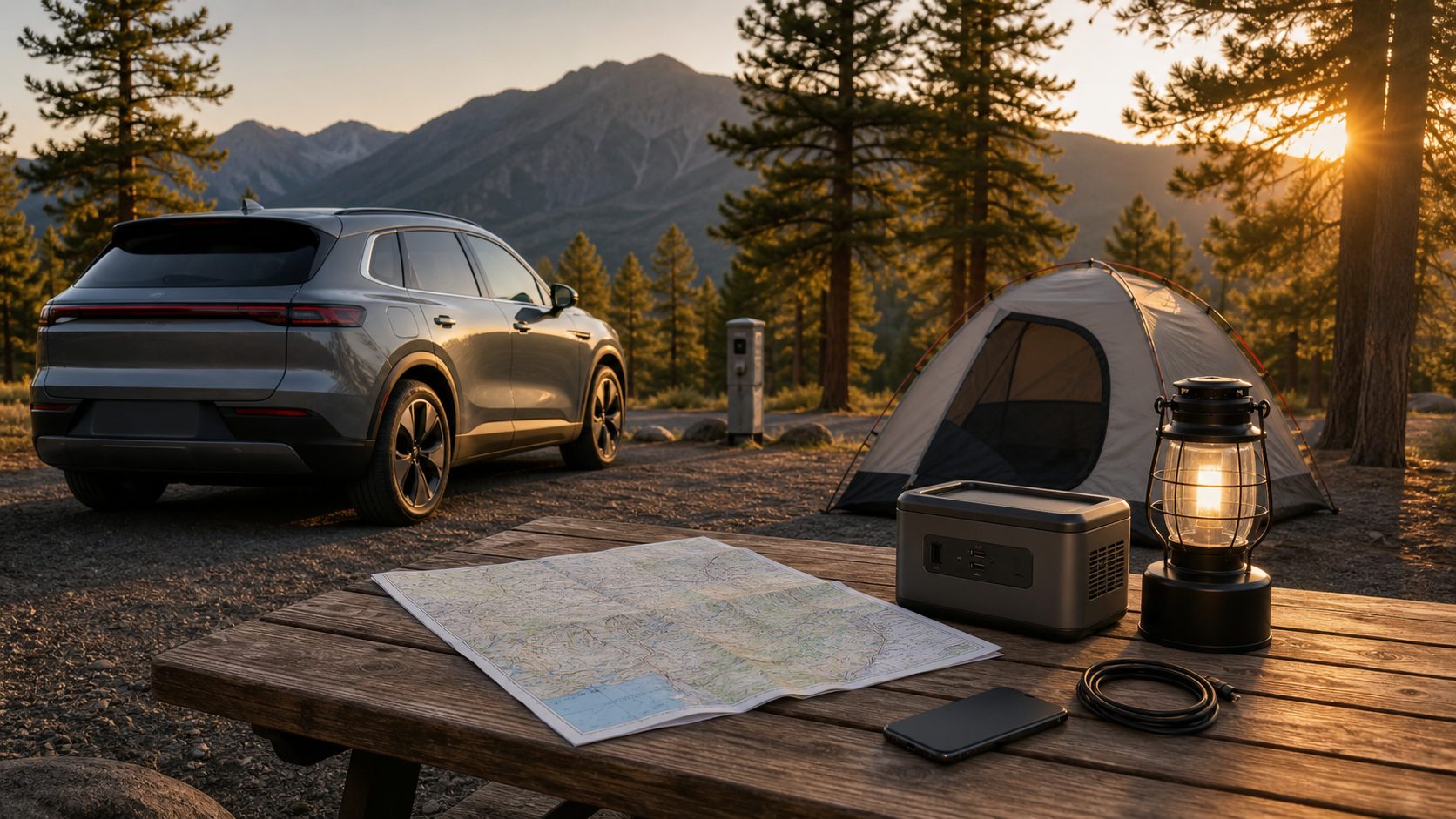
EV camping works best when you separate three jobs that often get mixed together: charging the vehicle, powering the campsite and backing up small devices. Your EV route needs verified public charging stops and range buffers. Your campsite needs confirmed amenities and permission rules. Your portable power plan should cover camp devices, not rescue a poorly planned vehicle route.
This guide is written for US campers planning campground-based trips with an electric vehicle. It is research-only, uses sourced claims and does not include affiliate links or hands-on product claims.
Quick Answer: Plan the EV First, Then the Campsite
Start with the vehicle, not the tent.
For an EV camping road trip, build the route around chargers that match your vehicle, then choose campsites that keep you within a comfortable driving buffer. The U.S. Department of Energy’s Alternative Fuels Data Center says longer EV trips should account for public charging stations along the route, charger compatibility and whether the vehicle can travel between stations within its expected range.
That last word matters: expected. AFDC also advises leaving extra range buffer when the trip includes hilly terrain, heavy loads, heating or air conditioning. Camping often adds at least one of those variables: cargo, rooftop gear, cold nights, hot afternoons, mountain roads or dirt-road detours.
- Map the driving legs between compatible public chargers.
- Add a range buffer for terrain, weather, load and detours.
- Confirm each charging stop with a current app, station listing or call-ahead check.
- Choose a campground within your arrival and departure buffer.
- Verify whether the campground has dedicated EV charging, allows campsite charging or prohibits it.
- Size backup power for phones, lights, navigation and camp devices, not for meaningful EV range recovery.
The goal is a trip that still works if one charger is busy, your campsite outlet is not available for EV charging or the weather uses more battery than expected.
Build the Route Around Verified Charging Stops
The charging plan should be boring before you leave. If it feels clever, fragile or dependent on a single late-night charger, add margin.
AFDC’s consumer guidance lists the general charging expectations this way: Level 1 can add about 2 to 5 miles per hour, Level 2 can add about 10 to 30 miles per hour, and DC fast charging can add 100 to 200+ miles in 30 minutes. Those are general ranges, not guarantees. Your actual result depends on the vehicle, battery state, charger output, temperature, tapering, connector and site conditions.
For a camping road trip, treat DC fast charging as the main route tool and Level 2 as an overnight or long-stop tool when it is truly available and allowed. Level 1 is useful for small top-ups in the right setting, but it is usually too slow to fix a poor road-trip plan.
- Set your starting state of charge and realistic arrival target.
- Check your vehicle’s native route planner, then compare it with public charger tools.
- Use the AFDC Station Locator or another current charger database to check public station options.
- Filter by connector, charging type and public access where the tool allows it.
- Look for a backup charger near each essential stop.
- Call ahead when a station is critical. AFDC notes that its station listings include phone numbers that drivers can use to check whether a station is operational and available.
- Save charger addresses offline before you lose cell service.
Trail Gear Review’s guide to camping apps for planning, weather and offline maps can help you build the app side of that workflow.
Do Not Treat Every Electric Campsite as an EV Charger
An electric campsite is not automatically an EV charging site.
The National Park Service tells campers to check campground facilities and regulations before going, including potable water, fire rules, group size, showers, toilets, food storage and reservations. NPS also notes that campers should consider whether they need electrical hookups, while RV and camper accommodations vary by park.
For EV camping, add a more specific question: May I charge my electric vehicle here, and from what exact equipment?
That question is not theoretical. A Recreation.gov listing for an electric site at Furnace Creek Campground shows 30/50 amp electric service, but the same listing says EV charging is not supported there and warns that plugging an EV into those pedestals could damage the vehicle and campground electrical system. That does not mean every campground has the same rule. It does prove the planning point: electric hookup details and EV charging permission are separate checks.
- Dedicated EV charging stations at or near the campground.
- Written campsite EV charging policy.
- Amp rating and hookup type for the site.
- Whether the outlet is intended for RV/camper use only.
- Whether EV charging adds a fee, needs staff approval or is prohibited.
- Where the vehicle must be parked while charging.
- Whether you must move after charging.
Some public recreation systems are adding dedicated EV chargers. Pennsylvania DCNR, for example, reports 50 public EV charging station locations at state parks and forests and asks drivers to move to another parking space after charging. That kind of dedicated charger is different from quietly plugging into a campsite pedestal without permission.
The conservative rule is simple: if you cannot verify that EV charging is allowed, do not build your trip around campsite charging.
What Backup Power Can and Cannot Do
Backup power is still useful. It just has a different job.
A portable power station, battery bank or small solar setup can help with phones, headlamps, camera batteries, lanterns, a small fan, satellite communicator, air mattress pump or other camp electronics. It can also preserve navigation and communication options if the vehicle is parked away from camp.
It should not be treated as a meaningful backup for a failed EV route. AFDC gives vehicle-scale energy context by noting that, at 12.3 cents per kWh, adding 100 miles of EV range would cost $2.46. That is a vehicle-charging energy scale, not a small-device backup scale. Plan your EV range through actual vehicle charging infrastructure.
- Phones and navigation devices.
- Headlamps, lanterns and small camp lighting.
- Satellite messenger or emergency communication devices.
- Camera batteries.
- Inflators, where compatible and within the power station rating.
- A small fan or comfort load, if weather and safety conditions still make the trip reasonable.
- Medical or critical devices only with a dedicated, manufacturer-approved power plan.
If you need help estimating device loads, use Trail Gear Review’s portable-power sizing guide as the companion article: How Much Portable Power Do You Need for Camping?
Campsite Power Safety Checks
Camp power is not only about capacity. It is also about weather, cords, batteries and combustion.
For extension cords and campsite electrical accessories, Electrical Safety Foundation International advises using cords rated for their intended indoor or outdoor use, making sure they meet or exceed the device’s power needs, inspecting for damage, keeping outdoor cords clear of snow and standing water and not overloading cords. For this article, that guidance applies to ordinary camp-device power. It is not permission to use a campground pedestal for EV charging when the campground has not approved it.
For lithium battery gear, keep the plan boring:
- Use intact, manufacturer-approved battery packs and chargers.
- Do not improvise with loose cells or incompatible chargers.
- Keep charging equipment dry and away from damage.
- Stop using a battery or charger that is swollen, damaged, overheating or recalled.
- Follow the manufacturer’s storage, temperature and charging instructions.
CPSC warns that loose lithium-ion cells without proper protection can short-circuit, overheat and experience thermal runaway. CPSC has also warned against incompatible universal chargers for battery products because of fire risk. Camp is not the place to experiment with improvised charging setups.
If you bring a fuel-powered generator, carbon monoxide becomes the central safety issue. CDC says portable generators produce carbon monoxide and should be operated outside more than 20 feet from windows, doors and vents, with battery-powered or battery-backup carbon monoxide detection. For camping, also keep generators away from tents, campers, vehicles used for sleeping and neighboring sites, and follow campground rules. Many campgrounds restrict generator hours or prohibit them in some loops.
Common EV Camping Mistakes to Avoid
- Assuming your normal commuter range applies to a loaded camping trip.
- Building a route around one charger with no backup.
- Arriving at camp with too little battery to leave if weather, fire, smoke or site conditions change.
- Treating a 30/50 amp campsite pedestal as an EV charger without written permission.
- Confusing Level 1, Level 2 and DC fast charging speeds.
- Forgetting connector compatibility and adapter needs.
- Depending on cell service to find your next charger.
- Using a portable power station as an EV emergency plan instead of as a device backup.
- Running cords through wet, damaged or overloaded setups.
- Using a generator in or near enclosed sleeping spaces.
- Charging batteries with mismatched or damaged chargers.
NPS camping safety guidance tells visitors to plan ahead, research risks, listen to warnings from park staff, know their limits and use good judgment with equipment and supplies. That applies directly to EV camping. The technology is useful, but the trip still needs the same outdoor margin as any other camping plan.
EV Camping Road Trip Checklist
Vehicle and Route
- Check your vehicle’s expected range with camping load, terrain and weather in mind.
- Build the route around compatible public chargers.
- Use DC fast charging for route legs where practical.
- Identify backup chargers near essential stops.
- Save charger addresses offline.
- Call ahead when a charger is critical to the route.
- Keep enough arrival battery to leave camp or reach a backup charger.
Campground
- Confirm the reservation, arrival time and parking rules.
- Check whether the site has electric hookup, no hookup or dedicated EV charging nearby.
- Ask whether EV charging from the campsite is allowed, restricted, fee-based or prohibited.
- Do not assume RV pedestal power is available for EV charging.
- Confirm potable water, restrooms, fire rules, food storage and weather alerts.
- Save the campground map and rules offline.
Backup Power
- Size portable power for phones, lights, navigation, communication and camp devices.
- Keep a separate plan for any critical medical equipment.
- Bring the correct manufacturer-approved chargers and cables.
- Do not rely on portable power to fix vehicle-route charging.
- Keep battery gear dry, shaded when appropriate and within manufacturer limits.
Safety
- Use outdoor-rated cords for outdoor use and do not overload them.
- Keep cords out of standing water, snow and high-traffic trip paths.
- Do not use damaged cords, batteries or chargers.
- If using a generator, operate it outside and well away from sleeping spaces.
- Follow campground generator rules and quiet hours.
- Carry offline navigation, a weather plan and an exit plan. For map redundancy, see Trail Gear Review’s offline navigation planning guide.
Bottom Line
EV camping is easiest when the charging plan does not depend on the campsite. Charge the vehicle through verified public or dedicated EV infrastructure, choose campsites inside a realistic range buffer and use backup power for camp devices. If a campground also offers approved EV charging, treat it as a useful bonus, not the only thing standing between a good trip and a stranded morning.