

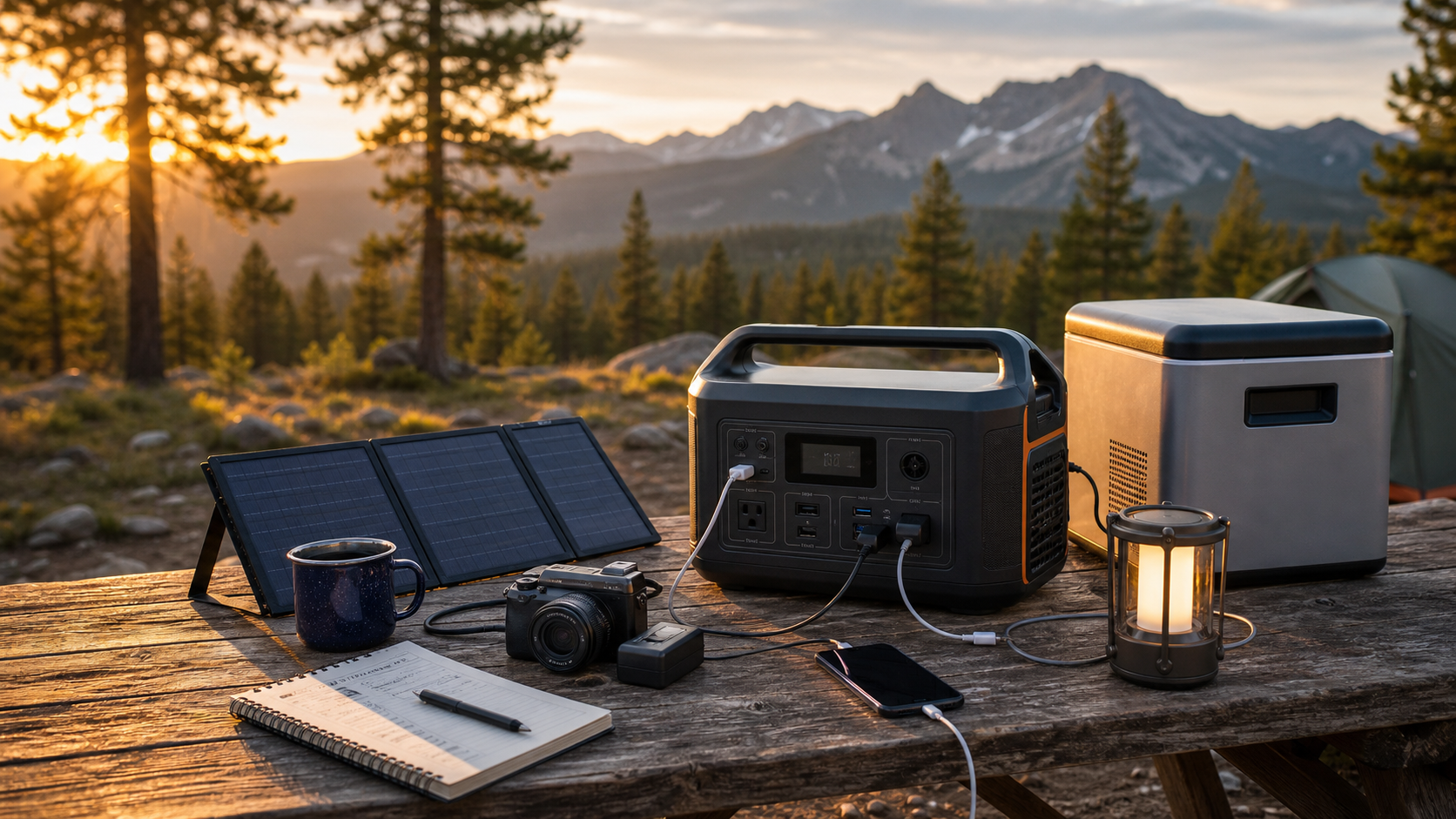
Most weekend campers should start by estimating one day of watt-hours, then multiply by the number of days between recharges and add a reserve. A light phone-and-lantern setup may only need a small power bank, while a fridge, camera kit, laptop, fan, or medical device can push the plan into portable power station territory.
The useful question is not what is the biggest battery I can buy. It is what do I need to run, for how many hours, with enough backup if the weather, route, or recharge plan changes. This guide uses research-only sources and simple math, not hands-on product testing or affiliate recommendations.
Quick Answer: Start With Daily Watt-Hours
A practical camping estimate starts with daily watt-hours: watts multiplied by hours of use. The U.S. Department of Energy explains the idea with a simple example: a 100-watt light bulb used for 10 hours consumes 1,000 watt-hours, or 1 kWh. For camping, the same logic applies to a lantern, camera charger, fridge, fan, or laptop.
- Add up each device’s watts x hours per day.
- Multiply by the number of days before you can recharge.
- Add a reserve of roughly 20% to 30% for inverter losses, cold weather, battery aging, and changed plans.
- Treat fridges, heated items, laptops, and medical devices as separate high-attention loads.
| Camping setup | What it usually covers | Planning range before reserve |
| Phone-only backup | Phone, watch, headlamp, small USB light | about 20-80 Wh per day |
| Light weekend power | Two phones, lights, camera batteries, small speaker | about 100-250 Wh per day |
| Comfort camping | Phones, lights, camera gear, fan, laptop use | about 250-600 Wh per day |
| Fridge or medical-device setup | Compressor fridge, CPAP or other critical device, longer no-recharge window | often 600 Wh+ per day, device dependent |
Those ranges are not product test results. They are a worksheet starting point. Your actual number should come from your device labels, manuals, charger ratings, and the way you camp.
How to Calculate Camping Power Needs
The basic formula is simple: Watts x hours = watt-hours. If a light draws 5 watts and you use it for 5 hours, budget 25 Wh. If a laptop charger draws 60 watts for 2 hours, budget 120 Wh. If a fridge cycles on and off all day, do not use only the peak watt rating; look for the manufacturer’s daily energy-use data or measure it with a power meter before relying on it.
Power banks often advertise milliamp-hours, or mAh, instead of watt-hours. The FAA explains the conversion for lithium-ion batteries: divide mAh by 1,000 to get amp-hours, then multiply by volts to get watt-hours. A 20,000 mAh battery at 3.7 volts is roughly 74 Wh before conversion losses.
Common Camping Loads to Add Up
Start with a list of every device you plan to charge or run. Then separate occasional charging from continuous runtime. Phones, watches, headlamps, lanterns, cameras, drones, laptops, fans, fridges, CPAP machines, and emergency devices should all be counted from their own labels or manuals.
A compressor fridge is the classic camping-power trap. It may not draw maximum power every minute, but it can run across the whole day. Dometic’s CFX3 documentation, for example, lists model-specific energy-consumption data rather than a single universal camping number. Use the manual for your exact model, then add margin for heat and real campsite behavior.
Medical devices need even more caution. ResMed’s Air11 DC/DC converter guide is written for a specific accessory and warns about using the proper 12V or 24V supply, battery condition, overheating, fuse replacement, and not plugging the power cord into USB. Do not guess on medical-device power. Use the manufacturer’s guidance for your exact machine, cable, settings, humidifier use, and trip plan.
Example Power Budgets by Trip Style
One-Night Minimal Camp
A minimalist overnight setup might include one phone recharge, a headlamp, and a small lantern. If the total comes to 50 Wh for the night, a small USB power bank may be enough, especially if you are not flying with a larger battery and you can recharge at home the next day.
Weekend Car Camping Without a Fridge
For two people charging phones, running LED lights, topping off camera batteries, and maybe using a fan or tablet, the daily estimate can move into the 100-250 Wh range. Multiply by two nights and add reserve, and a mid-size power station may make more sense than several small power banks.
Camping With a Portable Fridge
A fridge changes the math because it is not a one-time recharge. It is a daily load affected by weather, ventilation, set temperature, how often it opens, and how full it is. Use the fridge manual or a measured power draw, then plan for the full time between reliable recharges.
Power for Emergency Devices
Ready.gov recommends planning for batteries and alternative power sources, including portable chargers or power banks, as part of power-outage preparation. For camping, the same principle applies: communication, navigation, lights, and critical devices should not rely on a single optimistic battery estimate.
Devices That Need Extra Caution
Lithium-ion batteries are normal in camping electronics, but they still need careful handling. The U.S. Fire Administration warns that lithium-ion batteries can present fire dangers when users do not follow product instructions for use, storage, charging, and disposal. It also advises not charging lithium-ion batteries below 32 degrees F or above 105 degrees F.
Also check airline rules if you fly to camp. FAA guidance says many rechargeable lithium batteries and power banks up to 100 Wh are allowed without airline approval, 101-160 Wh generally require airline approval, and batteries above that range are restricted for passenger aircraft. Larger portable power stations are often not flight-friendly.
What Solar Changes and What It Does Not
Solar can reduce how much stored battery you need, but it does not erase the watt-hour budget. First calculate the load. Then decide whether solar is a bonus, a partial recharge plan, or a mission-critical charging source. Clouds, shade, short winter days, parked vehicles, and panel angle can all reduce real output.
Pre-Buy Checklist
- List every device you will charge or run.
- Find watts, watt-hours, volts/amps, or battery capacity from each device label or manual.
- Convert mAh to Wh when needed: mAh / 1,000 x volts = Wh.
- Estimate hours of use per day.
- Add continuous loads first, especially fridges, fans, and medical devices.
- Multiply by trip length between reliable recharges.
- Add 20% to 30% reserve.
- Confirm output type: USB-A, USB-C PD, 12V DC, AC outlet, or a manufacturer-specific cable.
- Check maximum output watts, not just battery capacity.
- Review lithium battery safety instructions and airline limits if relevant.
If the math points to a larger station, compare models after you know the size range. Trail Gear Review’s portable power station buying guide can be useful at that stage, but the sizing worksheet should come first. Pair the plan with offline navigation planning and a weekend camping checklist so power is part of the whole trip plan.
Bottom Line
For camping, portable power is a math problem before it is a shopping problem. Add watts x hours, multiply by the number of days between recharges, and keep a reserve for real-world losses. Phones and lights are usually easy. Fridges, fans, laptops, CPAP machines, and emergency devices are what make the sizing decision more serious.